| Detailed Description |
The Pāla School of art is seen at its best in Nalanda, then
a prosperous and developed town famed for its ancient
monastic university which attracted student-scholars from
China, Korea, Tibet, Mongolia and South East Asia. A great
number of metal images, pertaining to the Mahayana and
Tantrayana sects of Buddhist faith were cast during this
period being the outcome shilpasthanavidya, fine arts. The
smaller images were kept by the monks in their cells for
personal worship or to be taken away by pilgrims. The
bigger images were kept in public halls and chapels. Among
the high-lights of the National Museum's collection of the
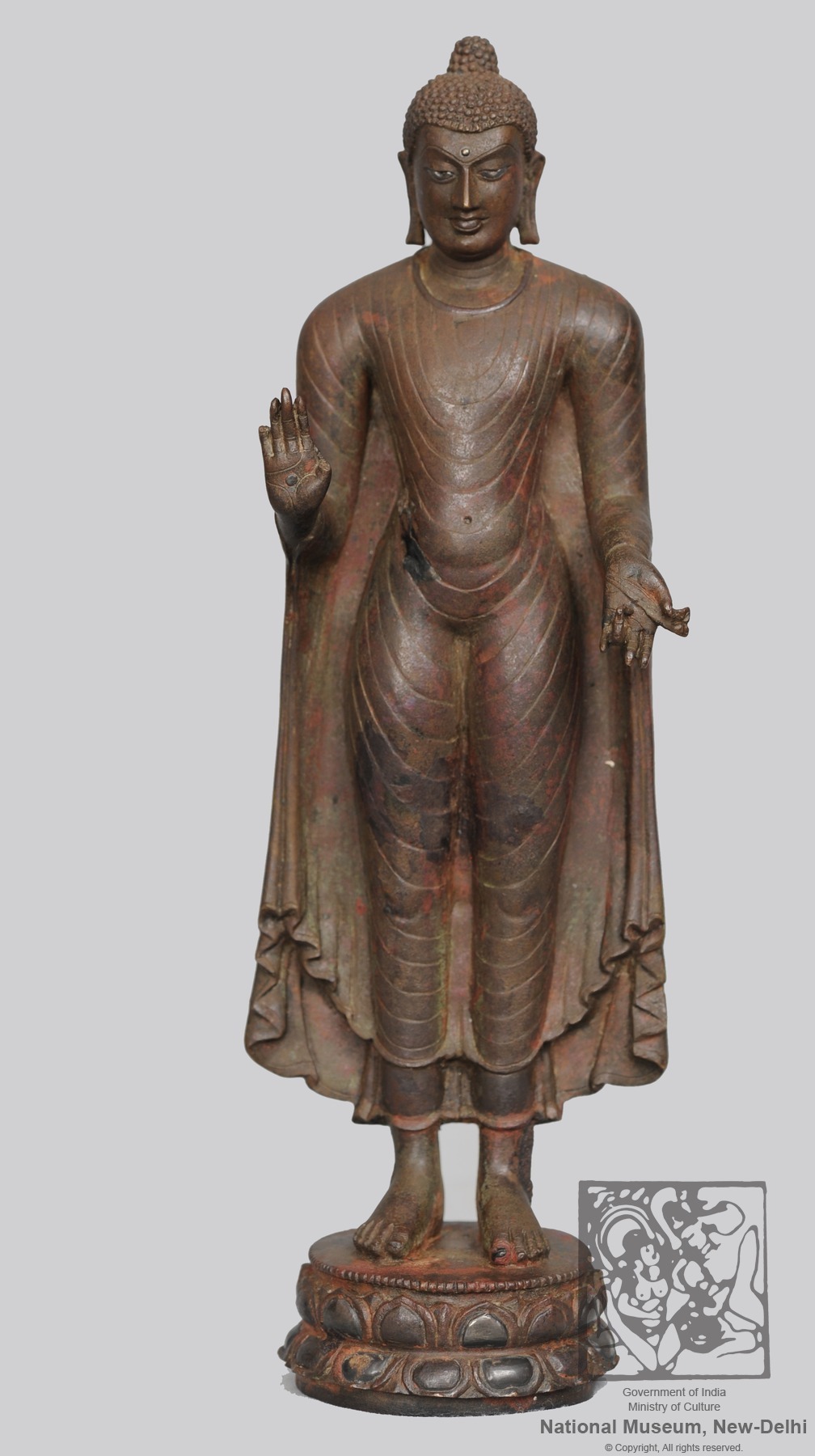
Nalanda bronzes must be included this standing Buddha. Śākyamuni Buddha, gracefully stands on a circular double
lotus pedestal having a beaded border. His right hand
displays abhaya - mudrā, the gesture of granting freedom
from fear. His left hand holds the end of the sanghati,
monastic robe and displays varada-mudrā, the gesture of
granting boon. He has sharp features with semi-closed eyes
inlaid with silver. The figure also displays mahāpurusa-
laksanas, signs of supernatural greatness like the lotus
mark on his right palm, hair arranged in snail-shell curls
with a uṣṇῑṣa, cranial protuberance, elongated earlobes and
jālahasta, webbed fingers, with silver inlaid ūrṇā, whorl
of hair on the forehead between the eyebrows. The sanghāṭi,
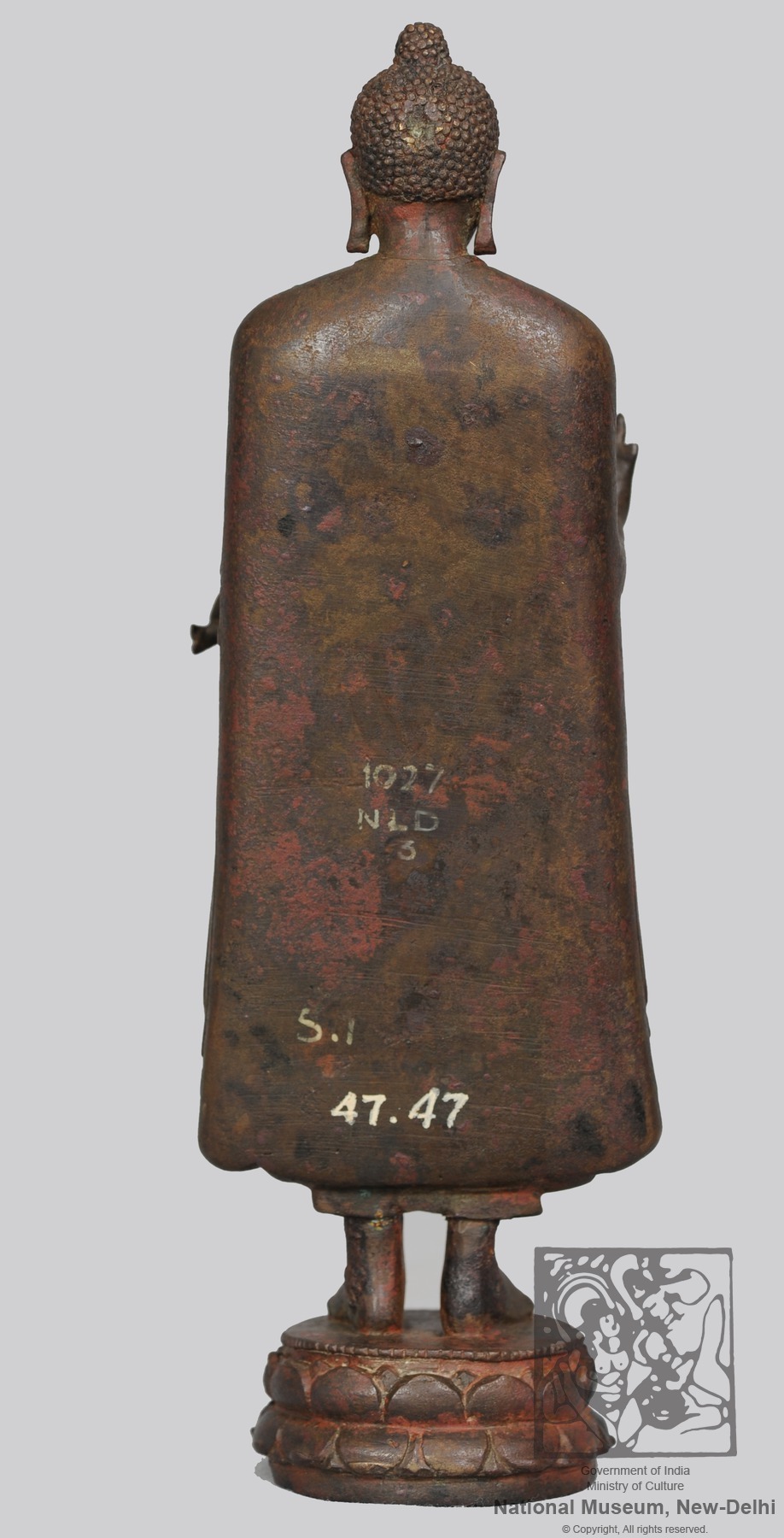
monastic robe is worn over both shoulders and is
schematically marked along the body contours. The pattern
of the lower edge of the robe above the ankles has been
skillfully rendered to ensure symmetry. This image also delicate and graceful modeling, linear in
style and the absence of elaborate ornamentation which
testifies to the skill of the metal-casters and the
continuance of Gupta sculptural idiom in eastern India and
its influence on the Pāla metal sculpture of Nalanda. |