| Brief Description |
Speeding into the forest, the bleeding and deformed Surpanakha went to her brother Khara, who was a mighty warrior. She told him about Rama, Sita and Lakshmana and how Lakshmana had deformed her. She then told her brother that she wanted to drink the blood of Sita and that he must defeat Rama. Khara sent fourteen demons to kill Rama but they were unable to harm him. Then, Khara along Dushan and a troop of fourteen thousand demons waged war against the two Ishavaku brothers. Dushan and his entire troops of demons were soon vanquished. Of the fourteen thousand, the only two remaining were Khara and Trishira. Rama annihilated them next.
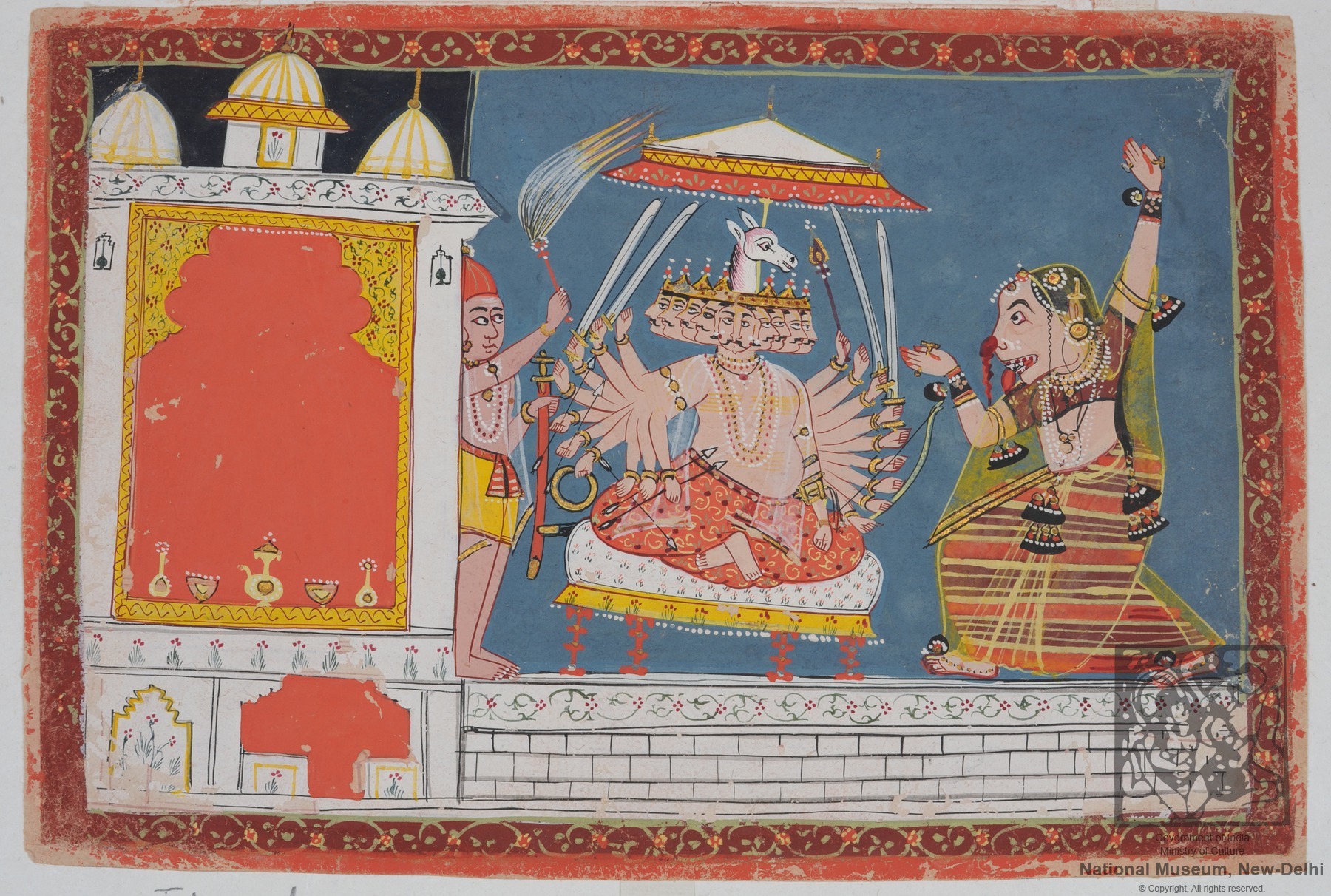
Surpanakha then reached Ravana's court and informed him of the death of Khara and Dushan and how Lakshmana had deformed her. She described Rama in detail, as the one who had defeated fourteen thousand single-handed and looked like the god of love. She then told Ravana about his wife, Sita, who was extremely beautiful and looked like goddess Lakshmi, the consort of Vishnu. According to Surpanakha, Sita was more beautiful that any gandharva, yaksha, kinnar or woman on the earth and advises him that he must make Sita his wife. Ravana, in order to appease his sister, devised a plan to abduct Sita.
Ravana listened attentively to the story narrated by Surpanakha. Appropriately crowned, with his ten heads and one donkey head, Ravana is seated on a golden throne with a parasol. An attendant stands besides him waving a flywhisk. Surpanakha now has her original appearance as an ugly demoness. Mutilated, with blood flowing, her appearance looks even more frightening with her nose cut off. Her arms are raised up as she speaks to her brother about the great insult and anger that she feels at the hands of the two Ishavaku brothers. The golden palace of Lanka is depicted on the left. Framed within a decorative floral border, both, this painting and the previous one, are from a series of Ramayana paintings made in the mid seventeenth century in Malwa, Central India. |