| Brief Description |
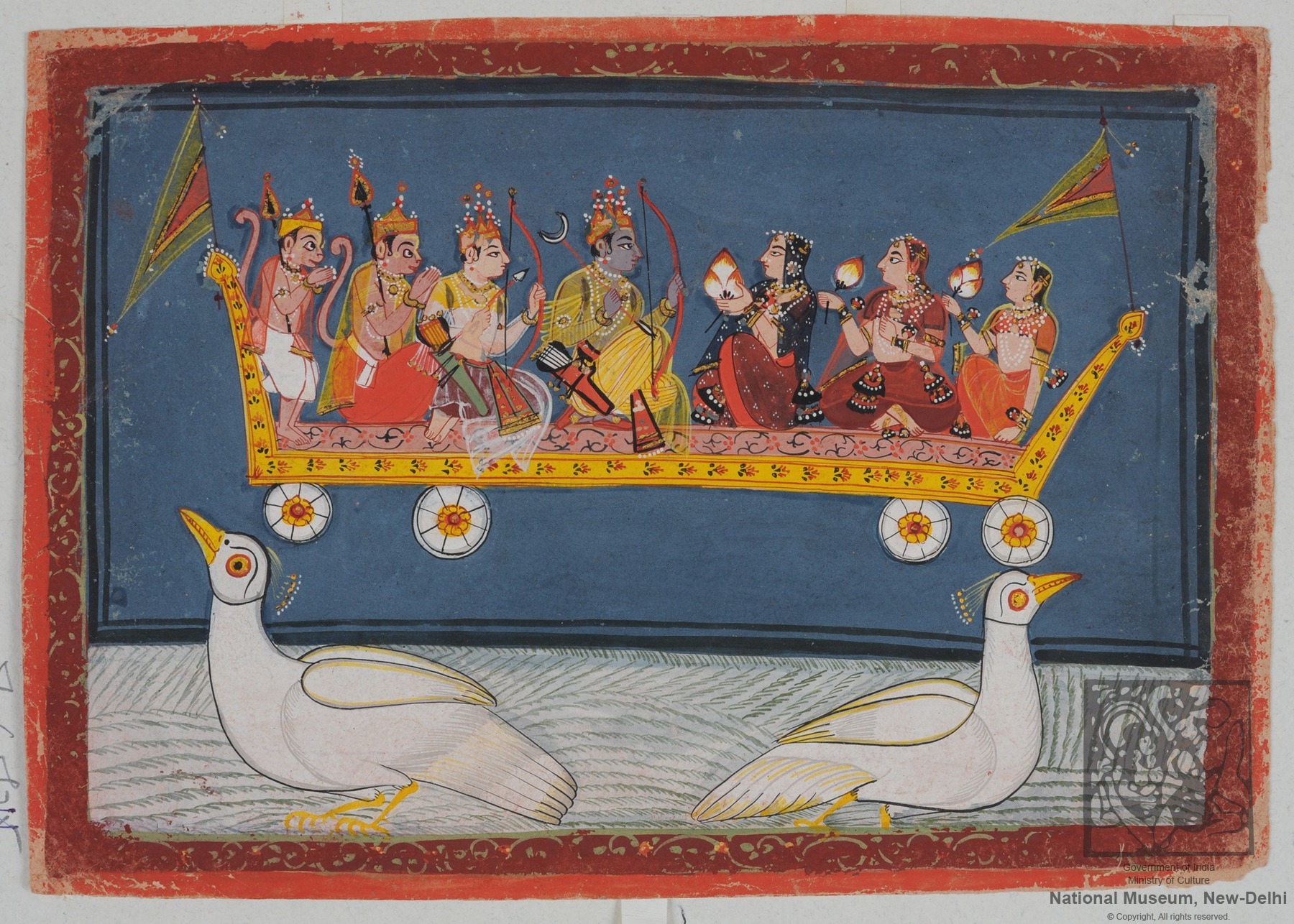
After the death of Ravana in the battle field, Vibhishana, the younger brother of Ravana, succeeds him as the king of Lanka. He offers Rama the Ravana's Pushpaka vimana for going back to Ayodhya without losing any further time. Rama accepts the offer and returns to Ayodhya with Sita and Lakshmana and Hanuman his ardent disciple. Pushpaka in Sanskrit means flower and vimana means flying palaces. The word Vimana comprises of Vi - the sky, and mana, meaning is measure; thus, Vimana is one that measures the sky as it traverses through it. Indian legends have many stories of Vimanas.
Pushpaka vimana was originally made by Vishwakarma for Brahma, the Creator. Later Brahma gifted it to Kubera, the god of wealth and the king of yaskshas, but it was later stolen by his half brother Ravana, who began using it for his own wicked ends. He used it even for the abduction of Sita and carries her away to his capital Lanka. While flying over Lanka in the Pushpaka Vimana Rama told Lakshmana that apart this the Pushpaka Vimana, Ravana owned many other Vimana too. Sage Valmiki mentioned this in one of the shlokas of the Yudha Kanda. The Pushpaka vimana was so accommodative that it had no dearth of space and there was always a room for one more person. The vimana went with the speed of mind and nothing could stop it on its way. Rama went directly to Nandigram, met Bharata and Shatrughna and then the aircraft was sent back to Kubera, its original owner.
In this Malwa painting, Pushpaka vimana is painted as a carrier with four wheels. On the edges of the vimana are seen the royal flags of Ayodhya. On the Vimana, there are Rama, Lakshmana, Angad and Hanuman with their weapons in their hands. Facing Rama, Sita is sitting with lotus flowers in her both hands. The two maids are also holding lotus flowers. The waves in the sea are painted with blue and white colours and the two cranes are sailing on the river watching the unusual spectacle of the flying vimana. |