| Brief Description |
Despite Bharata's great persuasions, Rama did not
return to Ayodhya from forest. Instead he commanded
Bharata to go back and look after Ayodhya, its people
and rule the kingdom during the years of his exile.
Bharata prayed to
Rama to give him his padukas and to allow him to
install them at the Ayodhya's throne and rule by them.
Finally, he returned with Rama's padukas, installed them
on the throne of Ayodhya and ruled the kingdom on the
behalf of Rama, and that too, not from Ayodhya but
Nandigrama, a nearby village. Here he lived like an
ascetic till the return of Rama. Bharat has remained as
the model of brotherly love, affection and devotion for
Hindus over the centuries.
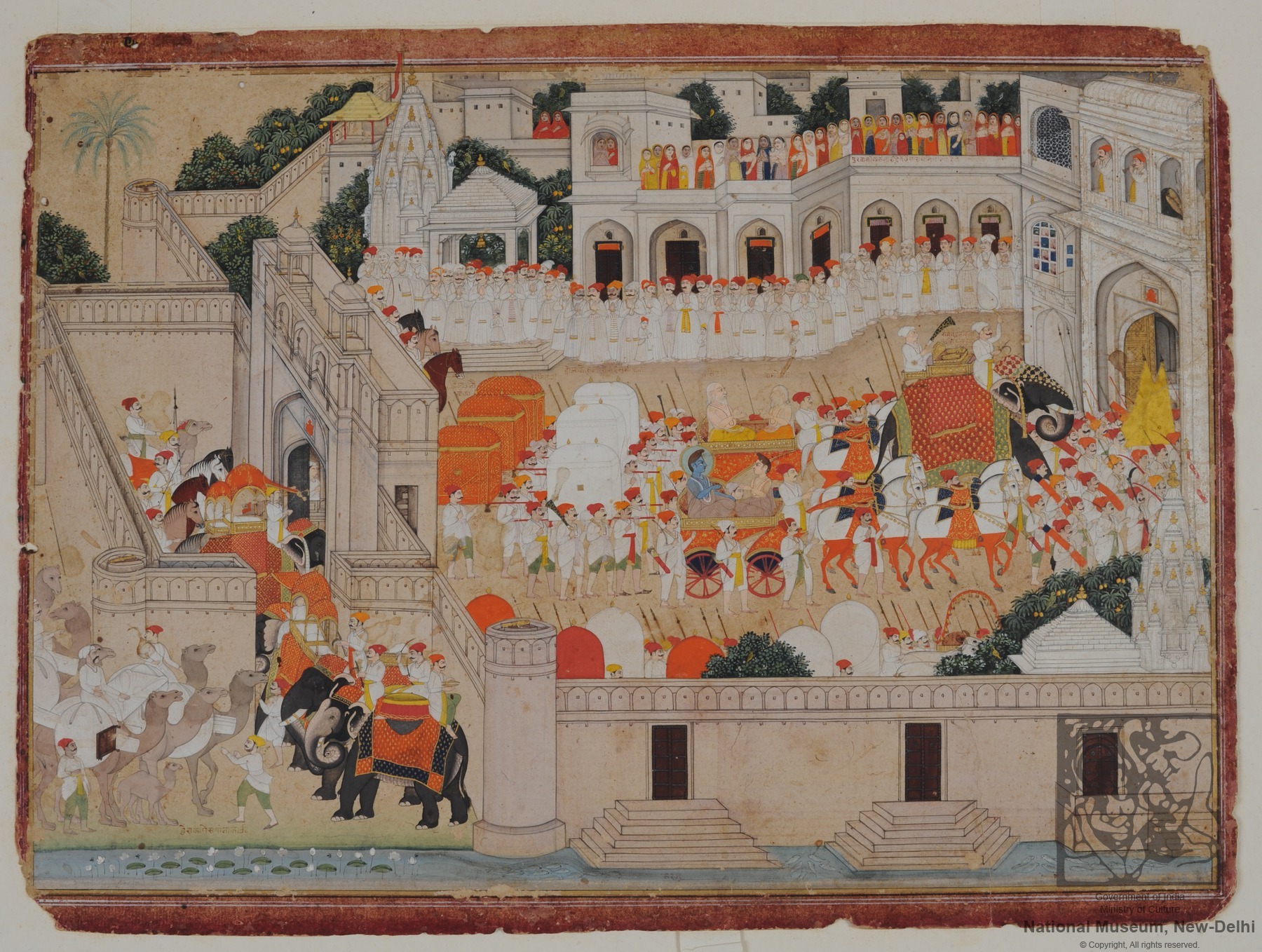
In this painting Rama's padukas are being brought back
to Ayodhya on a profusely decorated royal elephant in a
grand procession of chariots, horses and palanquins.
Behind the elephant in a chariot Bharata with his
younger brother Shatrughna, and on the other, sage
Vashishtha with sage Vamdeva. The artist Guman painted
two types of palanquins - white for Rama's three mothers
because they were widows, and red, being symbolic of
those women whose husbands are alive, for the three
consorts of his younger brothers.
The well-drawn various architectural dimensions are
clearly indicating the architecture of Jaipur city which
was built by Sawai Jai Singh of Jaipur in 1730 AD. The
presence of camels and its riders conspicuously reminds
that this painting is from the desert land of Rajasthan. |