| Brief Description |
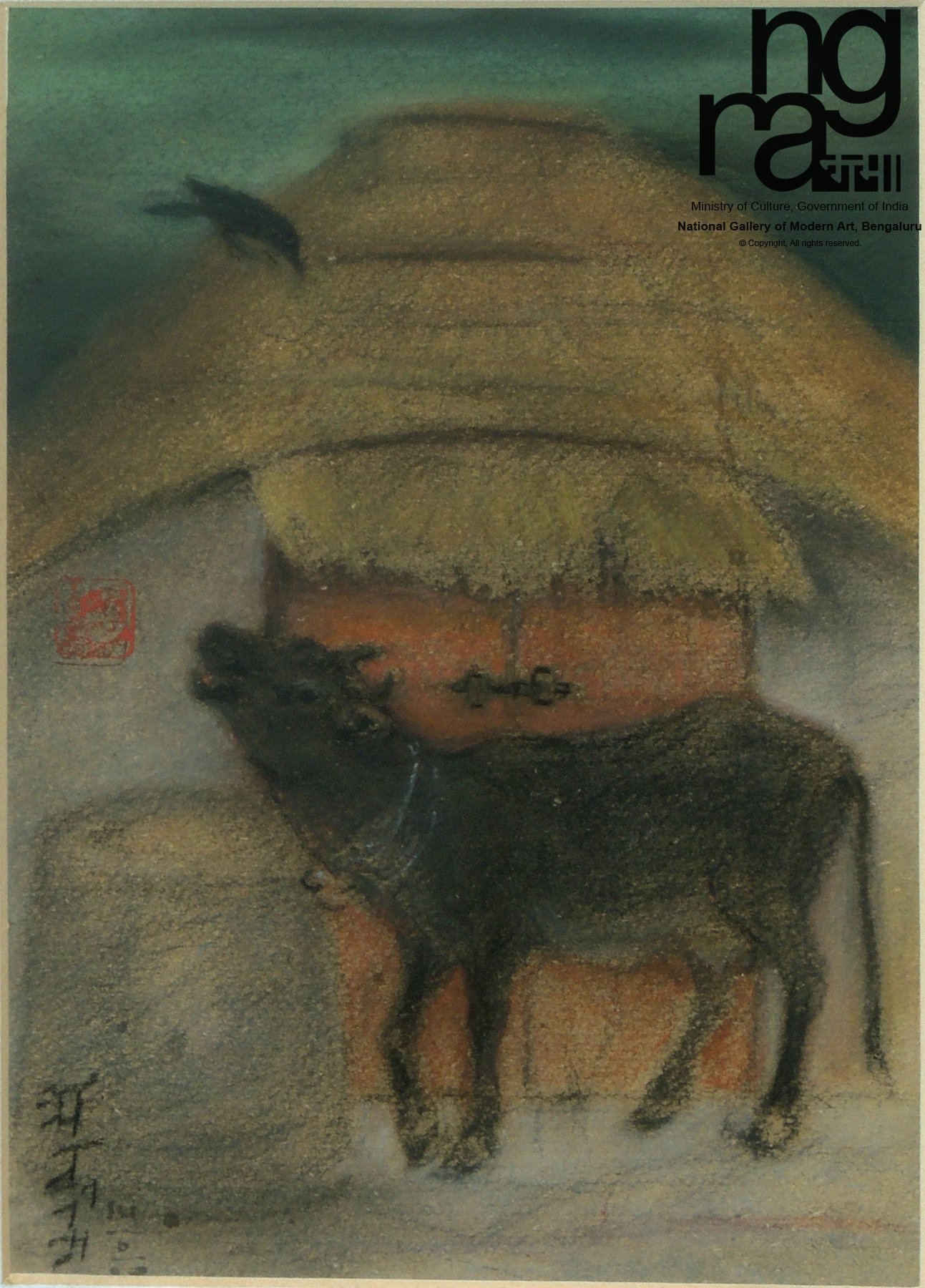
This delicately portrayed scene, depicts a crow and a cow, possibly
in conversation, aside a thatched house. A faint hazy orange circle
can be the setting sun. The medium of pastels, lends itself to give
the painting a feeling of twilight.
The greenish-blue horizon
suggests that scene attempts to capture the time of early dawn. |
| Detailed Description |
Leader of the Revivalist Movement in the field of Modern Indian
Painting in Bengal, Abanindranath Tagore is also credited with a
key contribution towards ushering in the renaissance in Indian
painting. Abanindranath's inner urge for liberating Indian art
was further inspired by Okakura, a great Japanese artist and art-
critic who came to India with Swami Vivekananda. His work has a
great delicacy of feeling, unity of concept, a highly sensitive
range of color, tone, texture and poetic depth. His work was a
mixture of traditionalism and innovation. He aimed at comparing
nature in its transient forms and produce an image part object,
part sensuous, both transposed into each other. But his vision on
nature was always poetic, as was his personal form of expression. In Abanindranth's pictures we see, for instance his adherence to
the creation of Rasa (mood, flavor, taste) as being one of the
ultimate aim of art. His use of analogy and suggestion to evoke
emotion is very strong. Abanindranath Tagore continued to paint
from the mental vision typical of Indian art, and did not use
models. He has also categorically stated: "For let us not forget
that it is the artist and his creation that comes first, and then
the law giver and his codes of art. Art is not for the
justification of the Silpa Sastra, but the Sastra for the
elucidation of art." |