| Artist's Life Date / Bio Data |
Mohammed Abdur Rahman Chugtai was born in Lahore, Punjab in undivided India. He belonged to a family of traditional Persian artists and architects who worked in the Mughal court. Chughtai learnt Islamic ornamentation from a local artisan, Baba Mir Baksh. In 1911, he joined the Mayo School of Art in Lahore. Chughtai visited Kolkata in 1916 and was deeply inspired by the work of Abanindranath Tagore.
Chughtai's work shows the delicacy of miniatures and lyricism of the Bengal school. He drew his images from the mythological, historical and literary sources. His paintings portrayed both Hindu and Islamic themes. Chugtai's paintings used the bright colours of the miniatures and his flowing sinuous lines reflect the influence of Bengal School. Following Partition in 1947, Chugtai continued to remain and became Pakistan's national artist. |
| Brief Description |
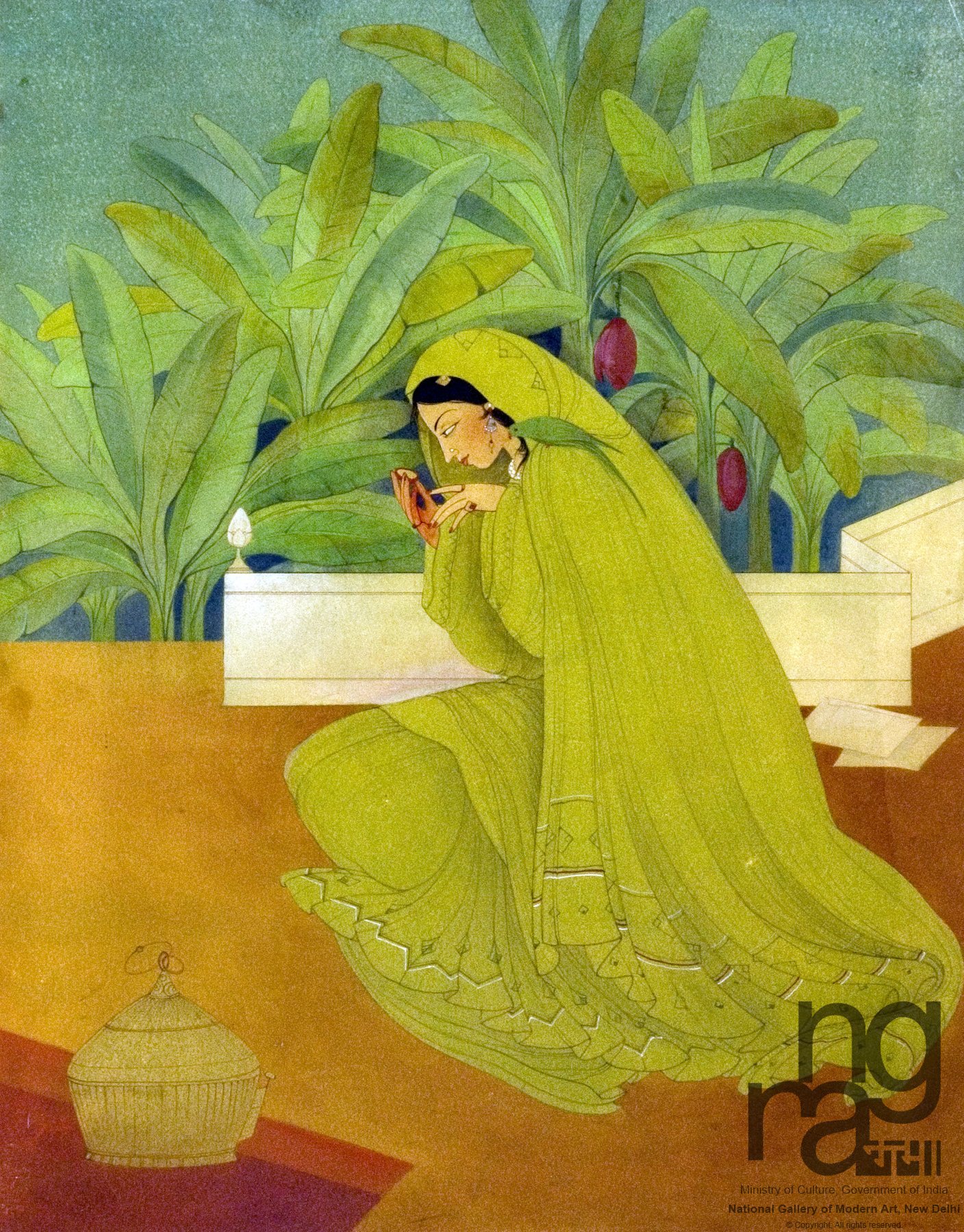
Princess Padmavati is seated on a terrace by a grove of banana trees, with her pet parrot perched on a shoulder. We are looking at Mohammad Abdur Rahman Chughtai’s famous work ‘Hiraman Tota’. The painting depicts Padmavati with her talking parrot, Hiraman. The tale of Padmavati was told by the 16th century Sufi poet Malik Muhammad Jayasi. The poem in Awadhi is about Padmavati, a Singhala princess who later became the queen of Chittor, her husband Rana Ratansen and the Sultan of Delhi, Alauddin Khilji.
Chughtai was known for his simple compositions, luminous colours and delicate draughtsmanship. His paintings brought to life myths, legends and folklore. Equally beautiful are his paintings of Hindu deities and Islamic stories and traditions. The artist was born in 1899 in a family whose ancestry could be traced to Chugatas, who served as architects in the court of the Mughal king, Babur. His early training in art was at Lahore's Mayo School of Art.
Later he studied under Samarendranath Gupta, a pupil of the Bengal School stalwart, Abanindranath Tagore. In Chughtai’s art we clearly see the influence of the Bengal School that derived a lot from Mughal painting, Japanese Wash technique and pan Asian ideals. |
| Detailed Description |
Hariman Tota is a beautiful visual reference by M. A. R. Chughtai to traditional Indian idea of the parrot as a messenger between lovers. This painting is inspired by the miniature style in its use of stylized rendering of banana plants and architectural elements in the background. The dainty little bird is perched on the shoulder of the Nayika, who is busy at her toilet. The scene is steeped in an exquisite romanticism. |