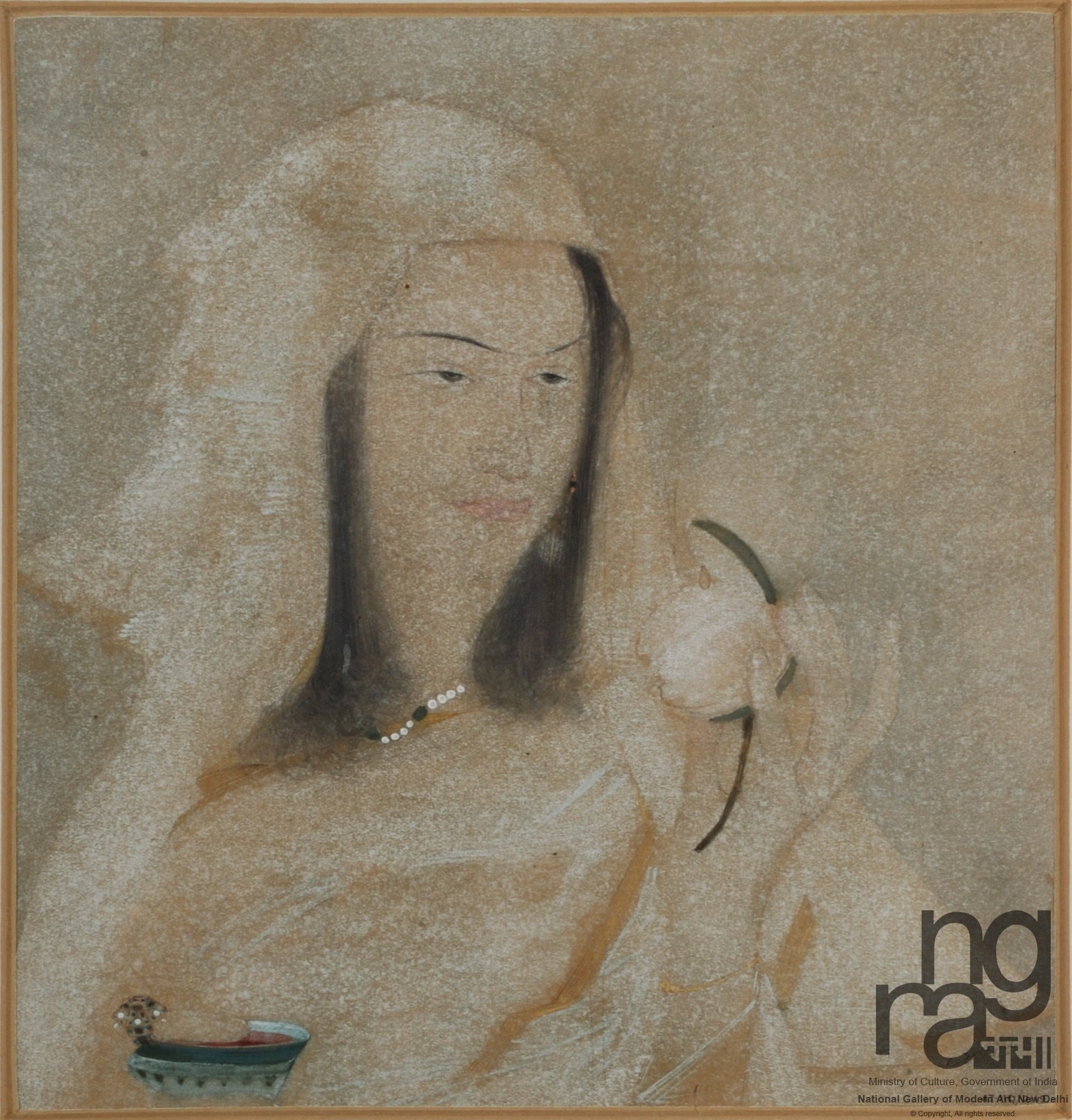
Abanindranath was born in the creatively distinguished family of Tagores of Jorasanko in Kolkata. In his youth, Abanindranath received training in European and Academic style from European artists, Olinto Gilhardi and C.E.Palmer. But sometime during the last decade of the 19th century, he developed distaste for the corporeality of European naturalism. Coincidentally, about the same time he received an album of Mughal miniatures and a book of English poems illuminated in the Art Nouveau style. These influenced Abanindranath's visual ideas deeply. A third source of inspiration came from the visit of the Japanese philosopher and aesthetician Okakura Kakuzo to Kolkata in 1902. Okakura's visit led to the coming of the Japanese artists Taikan and Hishida in 1903. The two Japanese artists taught Abanindranath the wash technique which appealed to the artists' romanticism.
These various triggers led Abanindranath to evolve a distinctive visual language that was delicate, sensitive, dreamy and rich in atmosphere he synthesized in his paintings the Western and Eastern aesthetics. Although, Abanindranath painted a range of subjects, he had a leaning towards painting images with historic or literary allusions. He liked to paint sets of images dealing with a theme or a text such as the 'Arabian Nights' or the 'Krishna Leela'. He also enjoyed painting theatrical subjects. Literature and drama held great respect for him and he was an elegant and accomplished writer.
Towards his sunset years, he started making whimsical sculptures with found material like driftwood. The NGMA has a few of his these works.
Country
India
Inscription
Signed 'Abanindra' in Bengali at the bottom right corner of the
painting with brush.
Dimensions
22 X 22.7 cms
Detailed Description
Nurjehan (1577-1645) was the wife of Mughal emperor Jahangir
and was said to have great influence over the Emperor.
Abanindranath painted a series of female figures between 1920
and 1925. These included a portrait of Nurjehan.
Art historian
R. Siva Kumar has written that Abanindranath visualized the
historical portraits after reading historical and literary
texts of the period.