| Artist's Life Date / Bio Data |
Born in Solapur, Maharashtra in 1920, A. A. Almelkar studied at the Sir J. J. School of Art, Mumbai. He started his artistic career as a landscape painter, taking inspiration from the Western impressionists artists. Slowly he moved to a more indigenous language, where he took impetus from classical Indian miniatures and ancient murals. Also inspired by the works of N. S. Bendre and Walter Langhammer and folk art traditions in the 1940s, Almelkar employed simplicity with regard to the use of color in his compositions.
The use of rhythmic, bold lines can be clearly seen as an influence of Indian miniatures in his works. He tried to merge Indian themes with modern techniques giving them an undertone of traditional folk art. He used detailed figurative and naturalistic drawings to narrate mythological stories and subjects.
He also served as the Principal of a private art school, Nutan Kala Mandir in Mumbai. He also joined J. J. School of Art as a lecturer in 1968. He was also invited as State Guest to Malaysia to deliver several lectures. In 1954, he received a Gold Medal from the Bombay Art Society, Mumbai. He was also honored with the Governor's Prize from Bombay Art Society Diamond Jubilee Exhibition, Mumbai in 1948. He participated in several solo as well as group shows in India as well as abroad including Malaysia, Singapore, Indonesia and Thailand. In his lifetime, he received from over twenty gold medals, twenty four silver medals & several cash prizes.
|
| Brief Description |
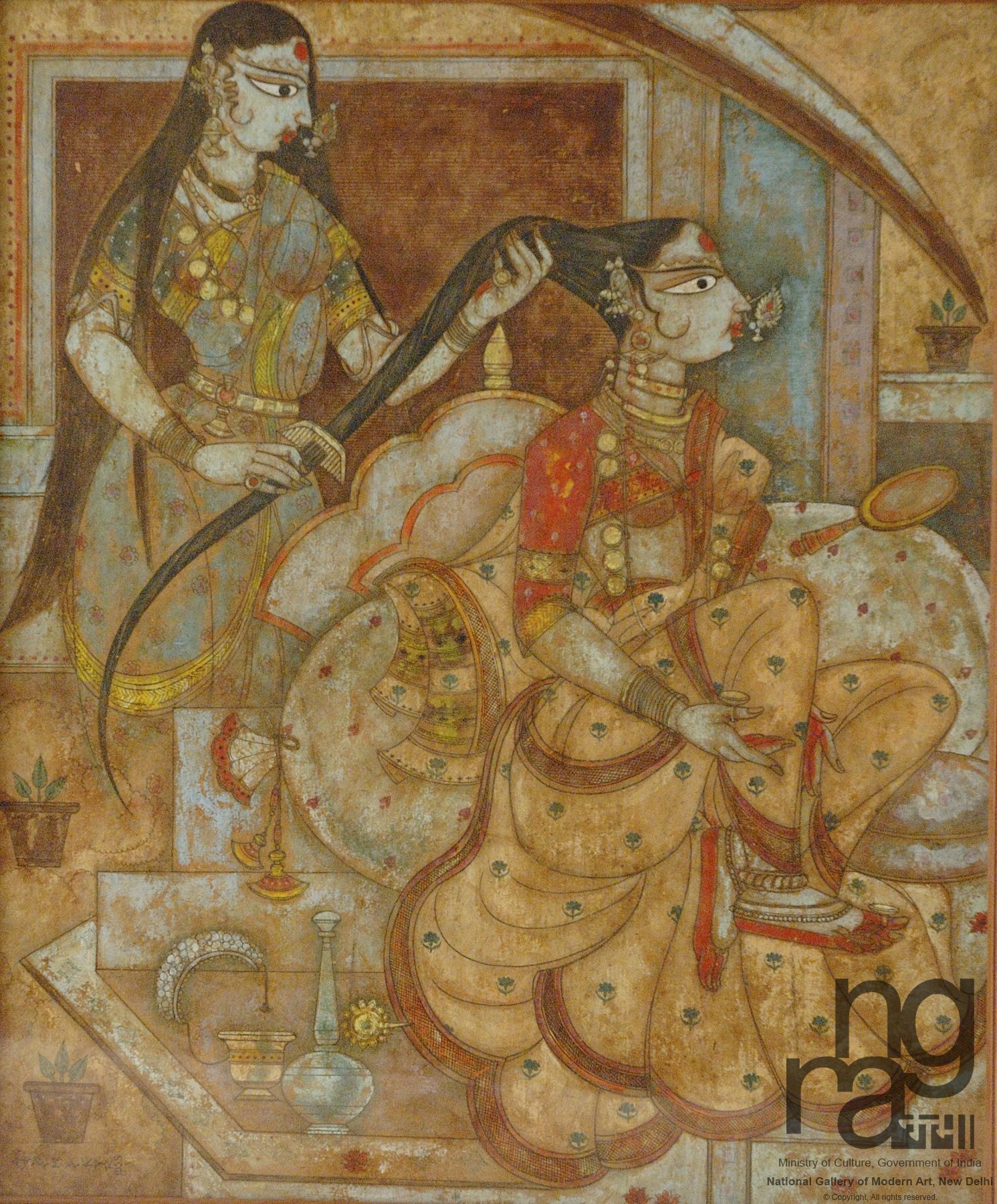
Here is a beautiful painting of two women, engaged in the everyday ritual of toilette. We see a seated woman and her companion combing her hair. The painting is infused with soft colours and has many intricate details, both architectural and decorative. There is a lyrical quality in the lines. The stylized faces are shown in profile and dominated by the large intense eyes. They remind us of the many schools of traditional Indian miniatures. This “Indian-ness” is typical of A A Amlekar’s style. His resistance to the emerging trends in modernism was well-known and was a subject of many good-natured arguments with his peers. Born in Ahmedabad, Abdulrahim Appabhai Amlekar studied art at the Sir JJ School of Art, Mumbai, from where he graduated in 1948. Amlekar was honoured with many prestigious awards including the Lalit Kala Akademi Award which he won twice – in 1956 and in 1960. He held as many as 40 solo exhibitions during his lifetime, many of them abroad.
His works gained immense popularity in Malaysia, Singapore and Indonesia. His travels within India took him to tribal villages where he stayed and worked for extended periods of time, often gifting his works to the villagers. |