Born to the family of Tagore's of Jorasanko, Kolkata, Gaganendranath was the elder brother of Abanindranath Tagore. With little formal training in art Gaganendranath began painting at an advanced age. He was inspired by the calligraphic brushwork and the wash technique of the visiting Japanese artists, Yokoyama Taikan and Hishida Shunsho. In the early 20's of the Twentieth century, Gaganendranath responded positively to the European modernist idiom. He began painting seriously when he started illustrating his uncle Rabindranath Tagore's autobiography in 1911.
Gaganendranath like his younger brother Abanindranath and uncle Rabindranath had a wide range of interests that covered theatre, fantasy and the like. He also practiced photography and this can be seen in the use of light and shadows in his paintings. From 1917 onwards he did a series of satirical caricatures of changes taking place in the society of his times.
Many of his paintings were referred to as 'cubist' because of the division of the figures and ground into geometrical planes. Gaganendranath painted portraits, landscapes, caricatures, abstract and 'cubist' paintings.
Country
India
Dimensions
25.4 X 31 cms
Detailed Description
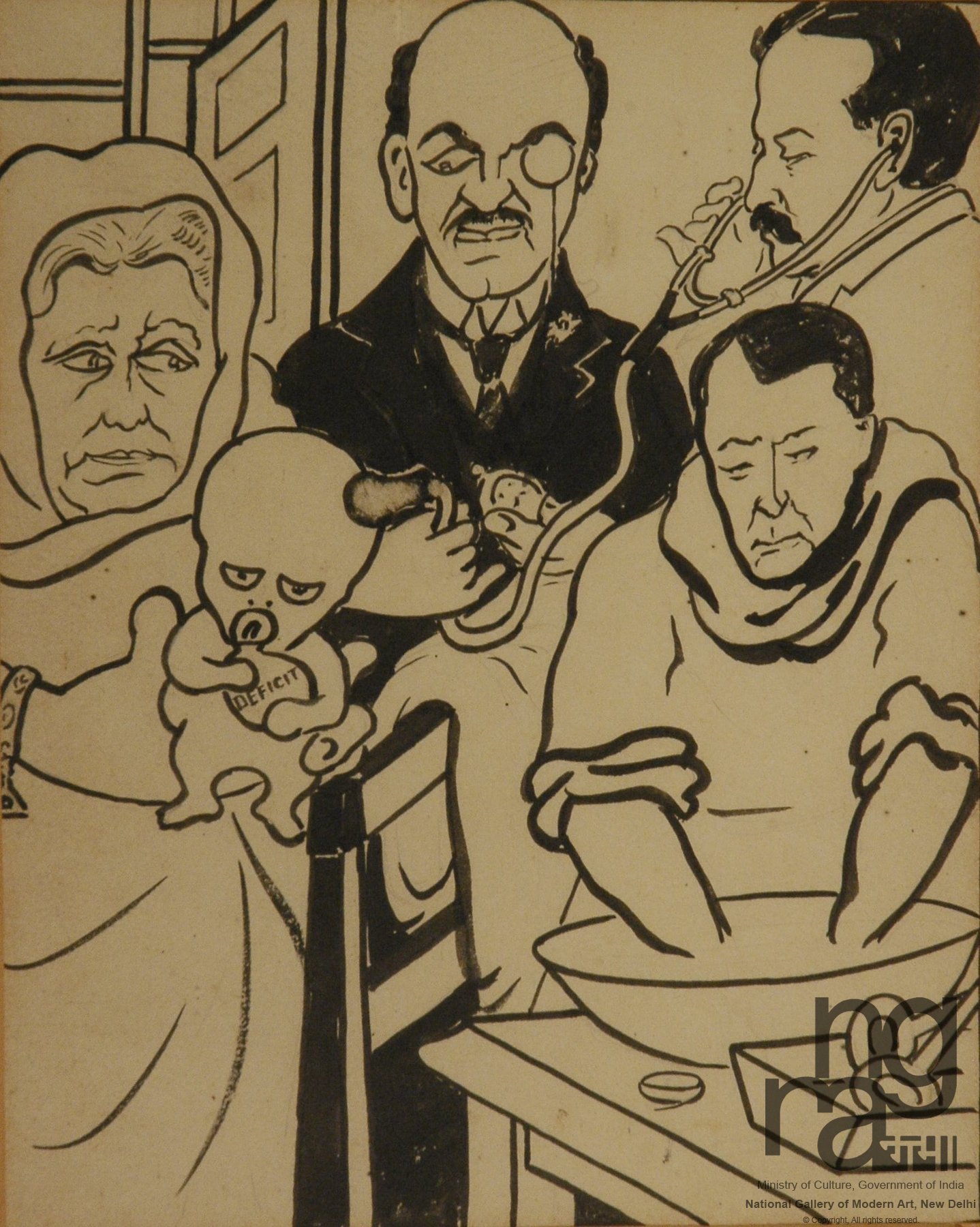
Gaganendranath Tagore began drawing cartoons and caricatures from 1915 onwards and continued them till 1921. He installed a lithographic press in the family mansion at Jorasanko had the drawings printed and often hand - coloured. The artist would comment on social and political developments particularly on the impact of the colonial rule.
A slightly altered version of this cartoon image has been printed in The Humorous Art of Gaganendranath Tagore, with an introduction by O.C. Ganguly, published by the Birla Academy of Art and Culture.
Art historian Ganguly says that the cartoon was drawn to make an ironic comment on the ineffective Montague - Chlemsford Act of 1919. Of the four figures in the drawing along with the new infant, the caricature of Mrs. Annie Besant, a strong advocate of the Home Rule Movement, is recognizable at the rear left.