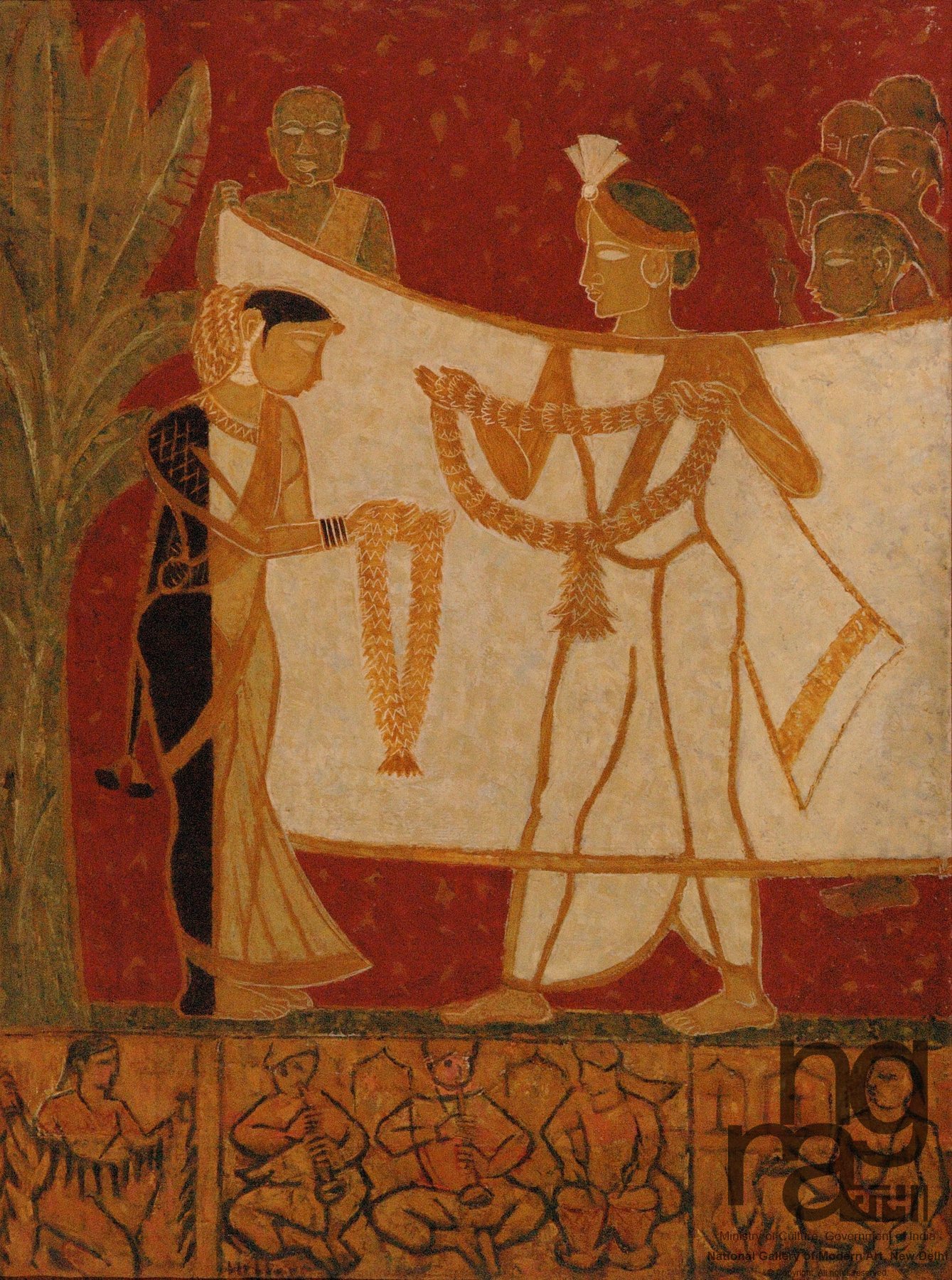
Kattingeri Krishna Hebbar was born in Karnataka and received his diploma in painting from the Sir J.J School of Art in 1938 where he taught art for a short period between 1940-1945. He later went to Europe and studied art at the Academy Julian in Paris. During his stay in Europe he was exposed to some of the best works of western art. It is on his return from Europe that Hebbar's body of works began to take a definitive shape.
Hebbar was prolific in his output and won many awards including the National Award by Lalit Kala Akademi in 1956, the Padma Shri Award in 1961 and Padma Bhushan in 1989. He served as the Chairman of the Lalit Kala Akademi (1980-84) and was the President of the Bombay Art Society in 1990. He died in 1996 at the age of 85.
Hebbar's repertoire includes depictions of landscapes and metaphysical spaces; however, majority of his work pertains to human beings- their interactions and conflicts, their suffering and resilience. He was particularly drawn to the simplicity of rural life. Dance and music provided him with boundless inspiration and is reflected in graceful sketches and paintings that picturise the abstract core of the subject. The rhythm of lines in his sketches and paintings highlights the integral link between music and art as both forms of creative expression search for an innate rhythm that defines the essence of the expression. In Hebbar's art the search for that quintessential rhythm sublimates the image from mere representation to a metaphysical experience. K.K Hebbar's works portray perfect blend of traditional Indian art forms and contemporary Western developments.