| Artist's Life Date / Bio Data |
Born to the family of Tagore's of Jorasanko, Kolkata, Gaganendranath was the elder brother of Abanindranath Tagore. With little formal training in art Gaganendranath began painting at an advanced age. He was inspired by the calligraphic brushwork and the wash technique of the visiting Japanese artists, Yokoyama Taikan and Hishida Shunsho. In the early 20's of the Twentieth century, Gaganendranath responded positively to the European modernist idiom.
He began painting seriously when he started illustrating his uncle Rabindranath Tagore's autobiography in 1911. Gaganendranath like his younger brother Abanindranath and uncle Rabindranath had a wide range of interests that covered theatre, fantasy and the like. He also practiced photography and this can be seen in the use of light and shadows in his paintings.
From 1917 onwards he did a series of satirical caricatures of changes taking place in the society of his times. Many of his paintings were referred to as 'cubist' because of the division of the figures and ground into geometrical planes. Gaganendranath painted portraits, landscapes, caricatures, abstract and 'cubist' paintings. |
| Brief Description |
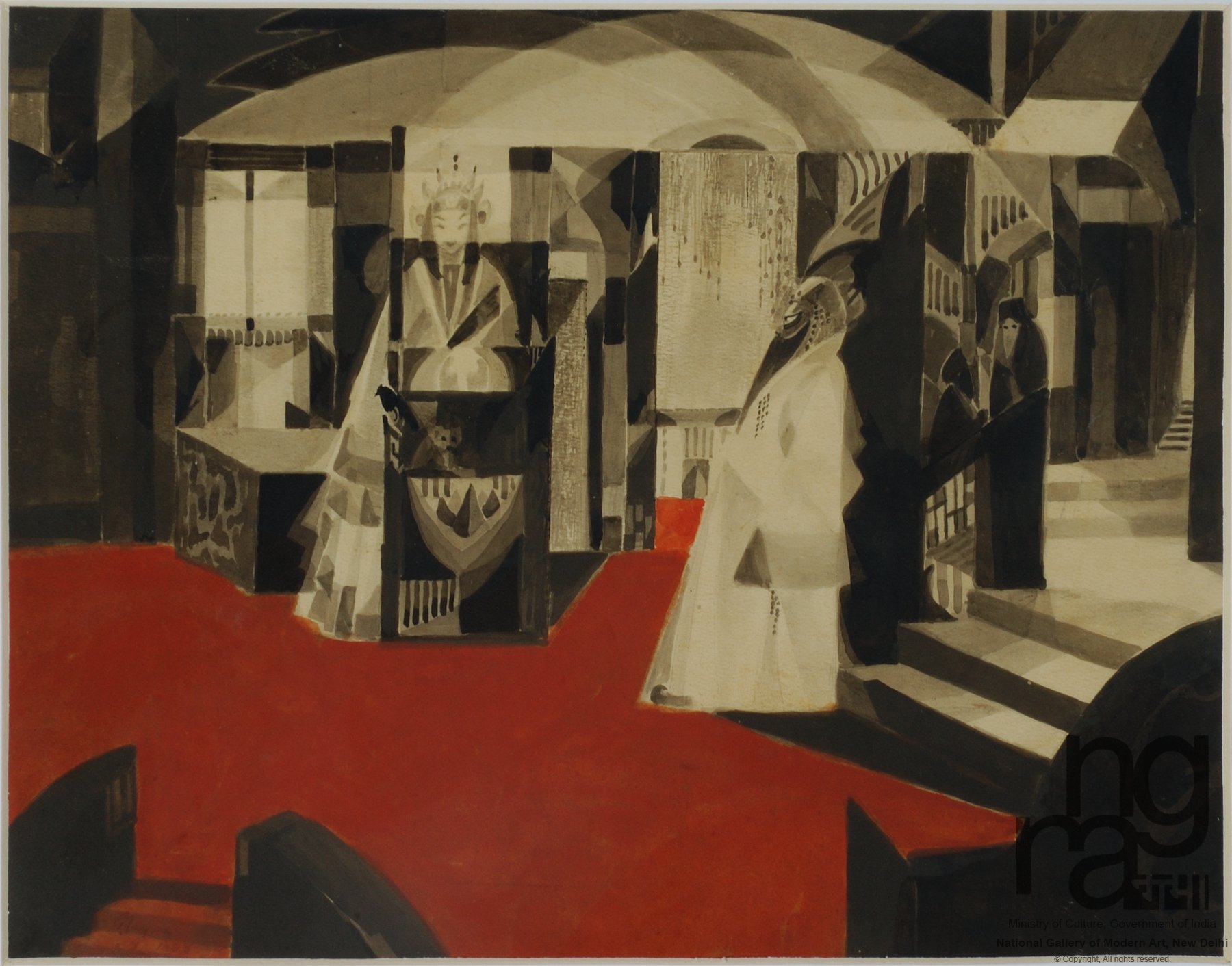
Many of Gaganendranath Tagore’s paintings are referred to as ‘cubist’ because of the way he divided the figures and the ground into geometrical planes. Although this self-taught artist was aware of the avant-garde cubist movement in European art and painting, his own ‘cubist’ paintings had little to do with it. In fact, Magician, a watercolour on paper, beautifully blends the many influences that the artist had absorbed. His multifaceted interests -- photography, architecture, theatre -- all seem to reflect on the canvas here.
Look at the central figure of the oriental woman in the painting, for instance. To the modern eye it looks like a superimposed photograph. The figure appears like an illusion, seen through the refracted white and black panel. The bearded man in white robes is the “magician”, looking at his work. Look at the brightly lit, receding spaces in the painting and the silhouetted woman at the back. You will also notice how the artist uses the colour red to hold the viewer’s gaze to the stage, as it were.
Magician was painted sometime around 1922 to 1925. At this time, Gaganendranath was actively involved in creating stage settings for his uncle, Rabindranath Tagore’s, plays at their Jorasankho residence. Art historians believe this had a considerable influence on composition in his paintings. |