
Portrait of Prof Mukul Dey
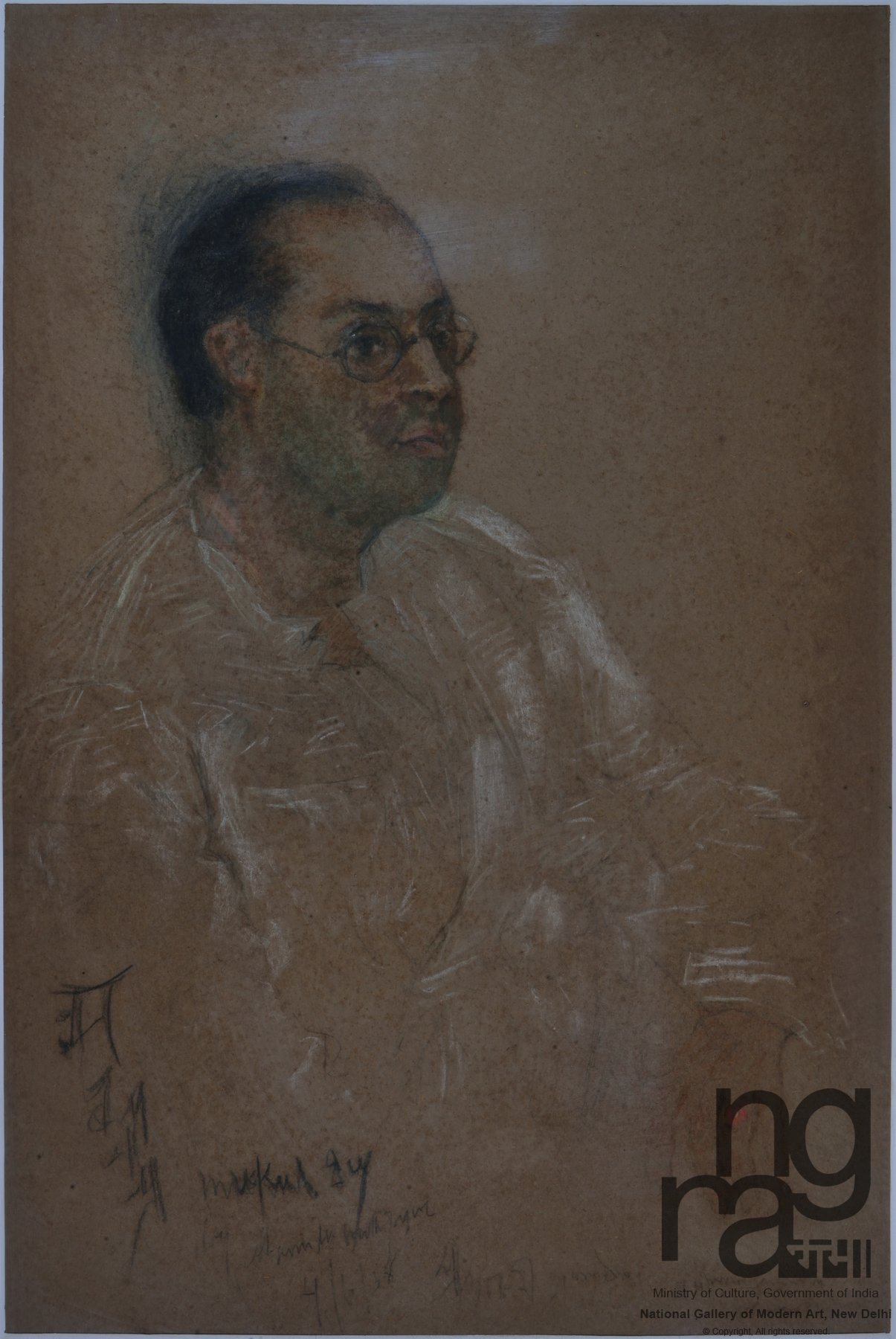
| Title | Portrait of Prof Mukul Dey |
|---|---|
| Accession Number | ngma-02662 |
| Museum Name | National Gallery of Modern Art, New Delhi |
| Gallery Name | NGMA-New Delhi |
| Object Type | Painting |
| Main Material | Pastel on Board |
| Main Artist | Abanindranath Tagore (1871 - 1951) |
| Artist's Nationality | Indian |
| Artist's Life Date / Bio Data |
Abanindranath was born in the creatively distinguished family of Tagores of Jorasanko in Kolkata. In his youth, Abanindranath received training in European and Academic style from European artists, Olinto Gilhardi and C.E.Palmer. But sometime during the last decade of the 19th century, he developed distaste for the corporeality of European naturalism. Coincidentally, about the same time he received an album of Mughal miniatures and a book of English poems illuminated in the Art Nouveau style. These influenced Abanindranath's visual ideas deeply. A third source of inspiration came from the visit of the Japanese philosopher and aesthetician Okakura Kakuzo to Kolkata in 1902. Okakura's visit led to the coming of the Japanese artists Taikan and Hishida in 1903. The two Japanese artists taught Abanindranath the wash technique which appealed to the artists' romanticism. These various triggers led Abanindranath to evolve a distinctive visual language that was delicate, sensitive, dreamy and rich in atmosphere he synthesized in his paintings the Western and Eastern aesthetics. Although, Abanindranath painted a range of subjects, he had a leaning towards painting images with historic or literary allusions. He liked to paint sets of images dealing with a theme or a text such as the 'Arabian Nights' or the 'Krishna Leela'. He also enjoyed painting theatrical subjects. Literature and drama held great respect for him and he was an elegant and accomplished writer. Towards his sunset years, he started making whimsical sculptures with found material like driftwood. The NGMA has a few of his these works. |
| Country | India |
| Inscription | Signed 'Abindra' in Devnagri and dated '4.6.38' in English in the bottom-left corner of the sketch. There is an inscription in English which can be read as, 'Mukul Day' (referring to the person in the portrait. |
| Dimensions | 57 X 88.5 cms |
| Brief Description | Between 1920 and 1925, Abanindranath Tagore made many portraits in different mediums. In the above sketch, he has rendered a portrait of the artist Mukul Dey, with soft strokes of pastel in tonal variation delineating the contours of the body and highlighting his facial features. |
| Detailed Description | During this phase of painting, Abanindranath Tagore revisited the Mughal visual idiom in pursuit of the 'authentic' as well as an 'identity' in his rejection of the colonial art practice. Abanindranath's inner urge for liberating Indian art was further inspired by Okakura, a great Japanese artist and art-critic who came to India with Swami Vivekananda. His work has a great delicacy of feeling, unity of concept, a highly sensitive range of color, tone, texture and poetic depth. His work was a mixture of traditionalism and innovation. He aimed at comparing nature in its transient forms and produce an image part object, part sensuous, both transposed into each other. But his vision on nature was always poetic, as was his personal form of expression. |


