Jamini Roy was one of the earliest and most significant modernists of twentieth century Indian art. From 1920 onwards his search for the essence of form led him to experiment with dramatically different visual style. His career spanning over nearly six decades had many significant turning points and his works collectively speak of the nature of his modernism and the prominent role he played in breaking away from the art practices of his time. Trained in the British academic style of painting in the early decades of the twentieth century, Jamini Roy became well-known as a skilful portraitist. He received regular commissions after he graduated from the Government Art School in what is now Kolkata, in 1916.
The first three decades of the twentieth century saw a sea-change in cultural expressions in Bengal. The growing surge of the nationalist movement was prompting all kinds of experiments in literature and the visual arts. The Bengal School, founded by Abanindranath Tagore and Kala Bhavana in Santiniketan under Nandalal Bose rejected European naturalism and the use of oil as a medium and were exploring new ways of representation. Jamini Roy, too, consciously rejected the style he had mastered during his academic training and from the early 1920s searched for forms that stirred the innermost recesses of his being.
He sought inspiration from sources as diverse as East Asian calligraphy, terracotta temple friezes, objects from folk arts and crafts traditions and the like. What was increasingly apparent from 1920 onwards was that Roy brought a joy and.
Country
India
Dimensions
36 X 26.5 cms
Brief Description
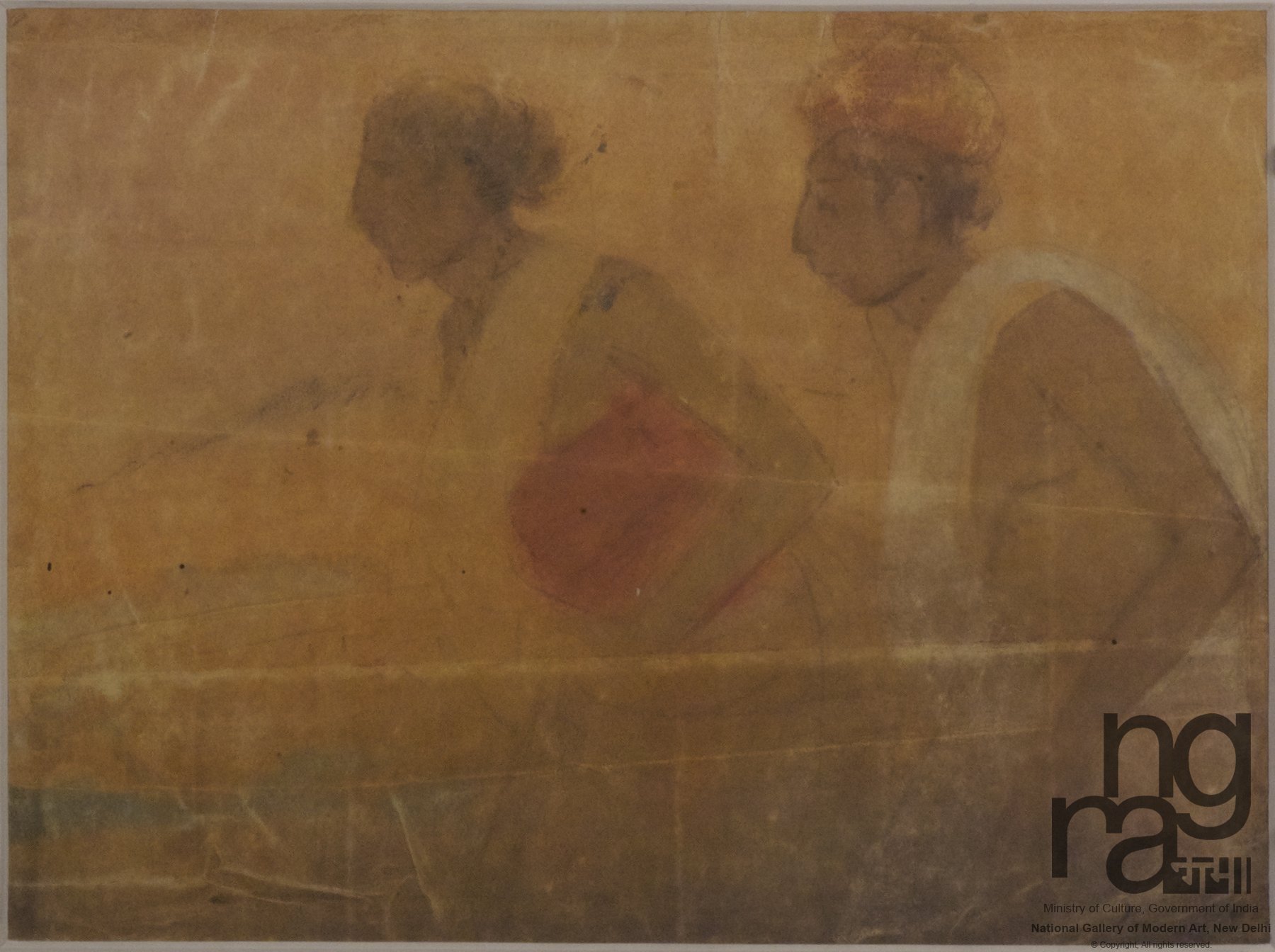
In the first few years of the 1920s, Jamini Roy did several paintings in what he called "flat technique." He had said that like Chinese landscapes, he discarded nonessential details in the backgrounds. The subjects were mostly Santal women and he brought to the figuration a certain sensuousness.
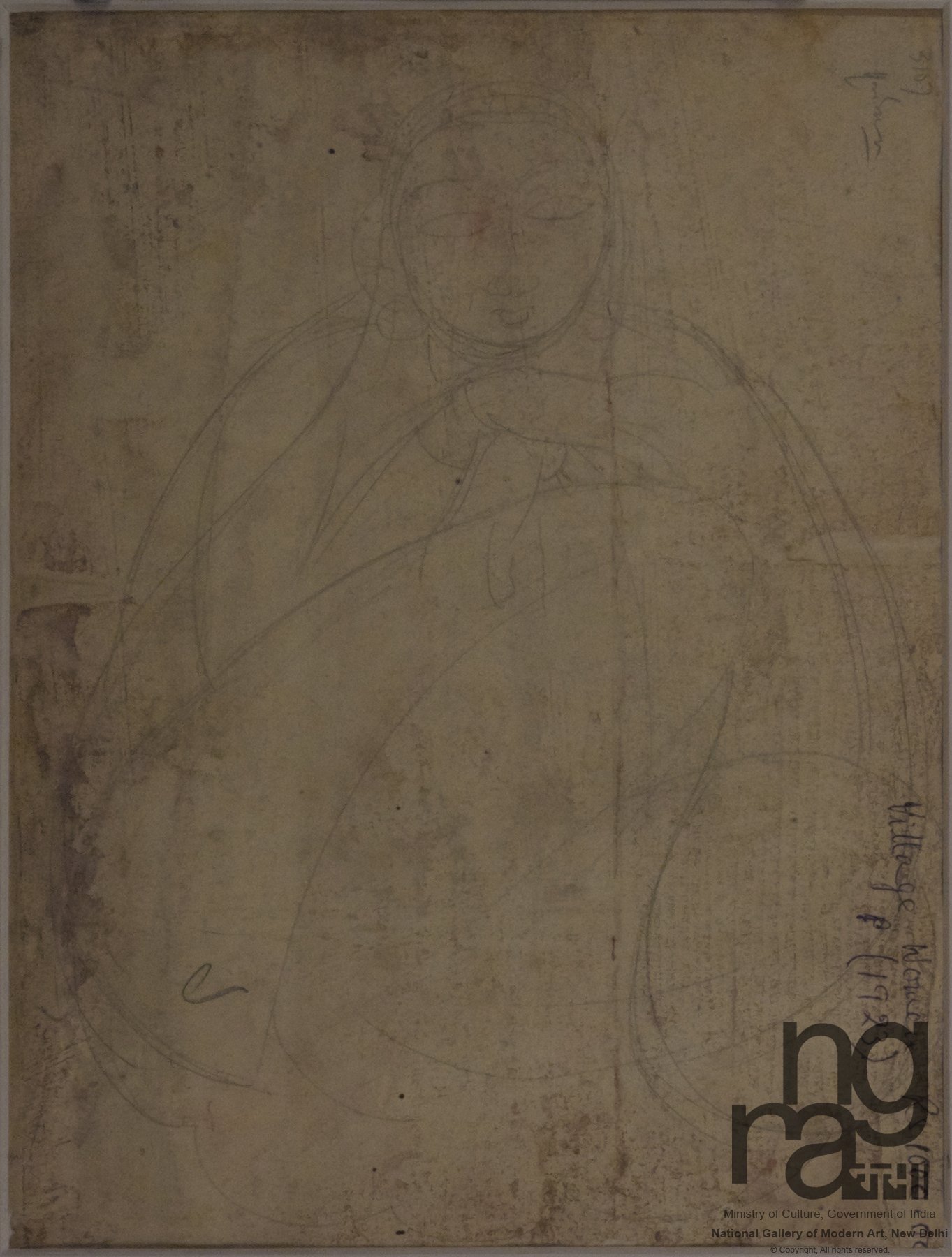
In this painting the style is similar to the "flat technique" but the subject is a Vaishnava couple. There is also a pencil sketch of a seated woman on the reverse of the painting with an inscription 'Village Woman, 1923' at the bottom right corner.
Detailed Description
In the early 1920s in quest of his individualistic visual
language, Jamini Roy made paintings using only one or two
colours to refer the skin tone and the colour of the garment
with application of paint being flat. He also evoked the
technique of discarding the non essential details in the
background as in the Chinese landscapes with the subjects being
mostly the tribal Santal women. The painting of the figures
against the backdrop of landscape were praised for their strong
angular lines and the romanticised portrayal of the indigenous
communities.