
Mother and Child (White Border)
| Title | Mother and Child (White Border) |
|---|---|
| Accession Number | ngma-03158 |
| Museum Name | National Gallery of Modern Art, New Delhi |
| Gallery Name | NGMA-New Delhi |
| Object Type | Painting |
| Main Material | Tempera on cloth |
| Medium | Tempera on cloth |
| Main Artist | Jamini Roy (1887-1972) |
| Artist's Nationality | India |
| Artist's Life Date / Bio Data | Jamini Roy was one of the earliest and most significant modernists of twentieth century Indian art. From 1920 onwards his search for the essence of form led him to experiment with dramatically different visual style. His career spanning over nearly six decades had many significant turning points and his works collectively speak of the nature of his modernism and the prominent role he played in breaking away from the art practices of his time. Trained in the British academic style of painting in the early decades of the twentieth century, Jamini Roy became well-known as a skilful portraitist. He received regular commissions after he graduated from the Government Art School in what is now Kolkata, in 1916. The first three decades of the twentieth century saw a sea-change in cultural expressions in Bengal. The growing surge of the nationalist movement was prompting all kinds of experiments in literature and the visual arts. The Bengal School, founded by Abanindranath Tagore and Kala Bhavana in Santiniketan under Nandalal Bose rejected European naturalism and the use of oil as a medium and were exploring new ways of representation. Jamini Roy, too, consciously rejected the style he had mastered during his academic training and from the early 1920s searched for forms that stirred the innermost recesses of his being. He sought inspiration from sources as diverse as East Asian calligraphy, terracotta temple friezes, objects from folk arts and crafts traditions and the like. What was increasingly apparent from 1920 onwards was that Roy brought a joy and |
| Country | India |
| Inscription | Signed 'Jamini Roy' in Bengali at the right bottom corner of the painting with brush and red colour. |
| Dimensions | Length:34.5 Width:76 centimeter |
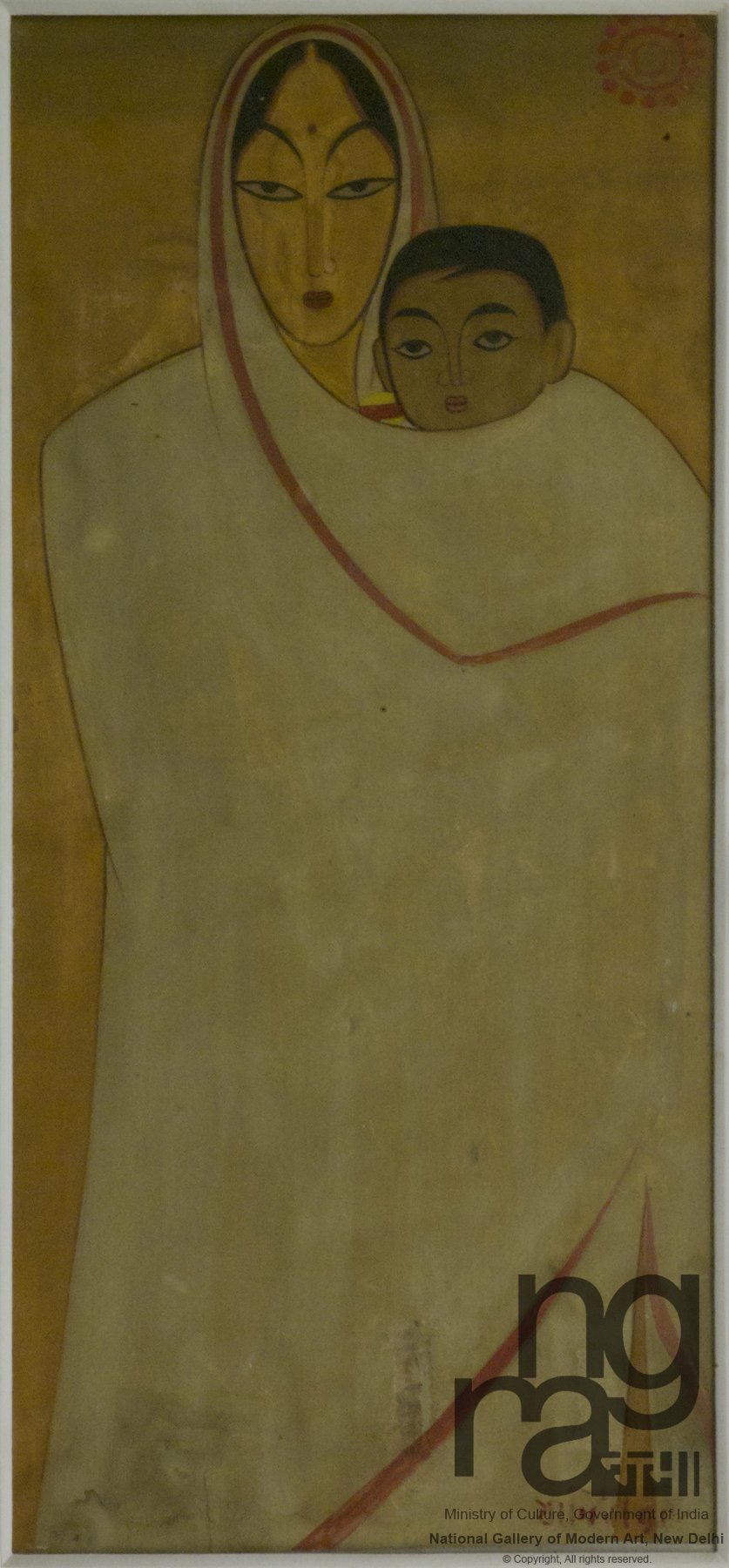
| Brief Description | In this painting of Jamini Roy, you see a mother holding a child in her arm. The mother’s white drape encompasses the entirety of the two figures. With bold outlines and minimal expressions, Roy is able to convey the universality of the subject – the mother’s protective tenderness towards her child. Almond shaped eyes, minimal colouring and bold, sweeping lines that are the markers of Jamini Roy’s work are all present in this painting. Notice that little circular decorative motif in red on the top right of the painting. The red colour is repeated in the sari border and the bindi on the mother’s forehead. Jamini Roy made infinite variations of the mother and child figures leading many scholars to wonder at what led him to experiment with this theme. |
| Detailed Description | It was probably around 1919 or 1920 that Jamini Roy moved away gradually from European naturalism in search of his own idiom. The Mother and Child image emerged as one of the favourite themes of Roy and here he evokes the mother's protective tenderness towards her child with great sensitivity.There are infinite variations of the mother and child figures. It is difficult to gauge at this distance of time what thoughts led him to experiment with this theme. One wonders whether the subject had an emotional charge for him. Were his experiments with the theme an outcome of Bengal's obsession with mother worship? Or was it just an interesting juxtaposition of forms which helped the possibility of endless explorations? This painting done against a yellow background shows the mother holding the child in her arms and with her drape beautifully encompassing their figures in entirety. Both the mother and child have the almond shaped eyes with a stimulating gaze and the innocence of the figures is strongly suggestive in their humble demeanour. The artist has astutely introduced the colour red in the circular decorative motif at the top right corner and in the hem of the garment. |


