
The Chuar Uprising, 1767 - 1802
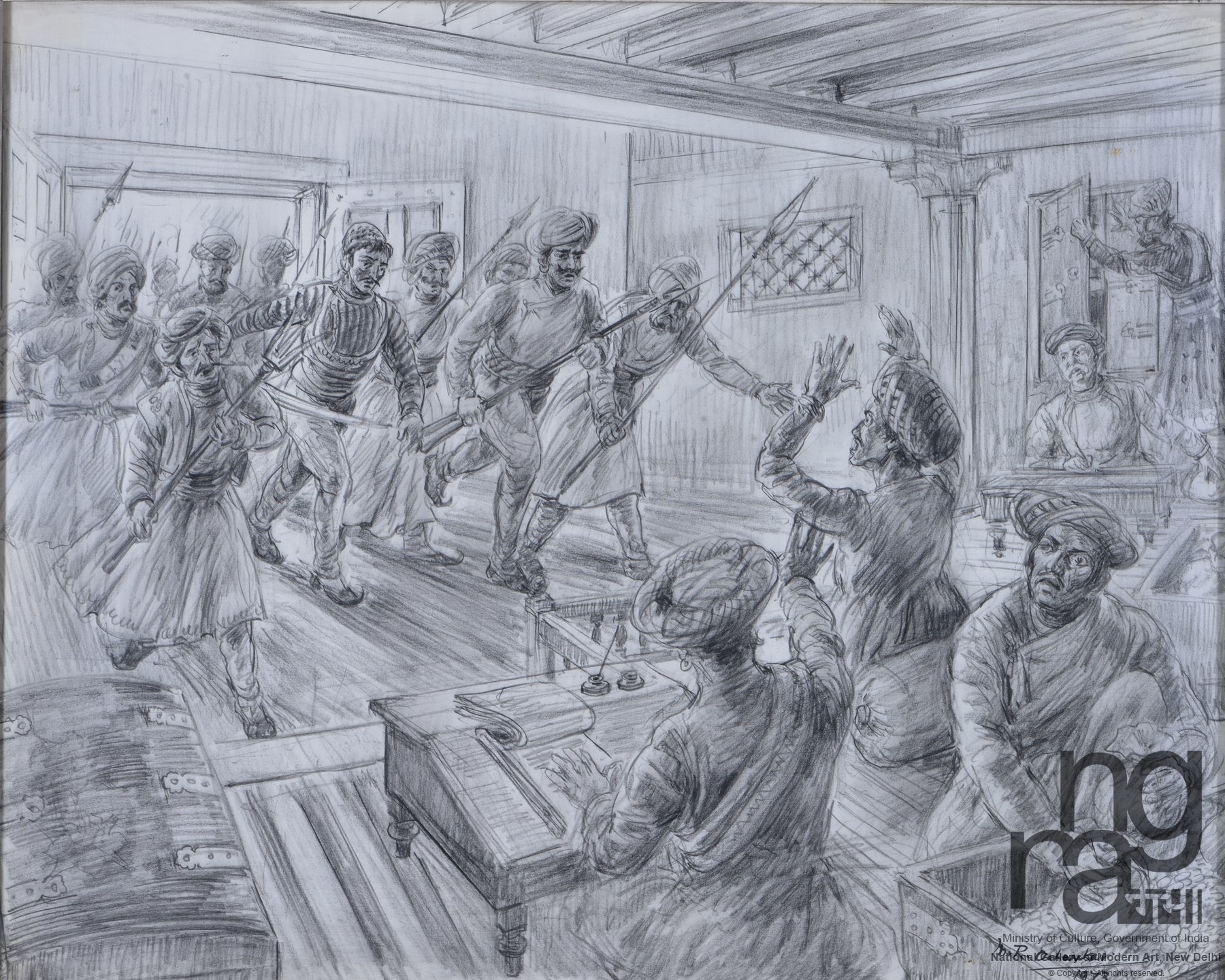
| Title | The Chuar Uprising, 1767 - 1802 |
|---|---|
| Accession Number | ngma-03635 |
| Museum Name | National Gallery of Modern Art, New Delhi |
| Gallery Name | NGMA-New Delhi |
| Object Type | Painting |
| Main Material | Pencil on paper |
| Main Artist | M. R. Acharekar (1907-1979) |
| Artist's Nationality | Indian |
| Artist's Life Date / Bio Data |
A Portraitist, watercolourist and an award winning Film Art Director Murlidhar Ramachandra Acharekar (1907-1979) completed his Diploma in painting from the Govt. College of Maharashtra, Bombay. While still pursuing his education he became involved in the discipline of Printmaking and Portraiture and soon opened up a lithographic press in Bombay. Post his education he was appointed as Junior Teacher at the Ketkar Institute of Art, Bombay in the year 1923. From 1932-34 he spent two years studying European Art and its techniques at the Royal College of Art, London. While studying in London, Acharekar was chosen to execute some very important commissions as painting the historical event of the inauguration of the Round Table Conference by his late Majesty King George V of the United Kingdom, in 1932 and the Silver Jubilee Celebrations of King George V in 1935, to name a few. Acharekar also emerged as an educator when his famed book called 'Rupadarshini, An Indian Approach to Human Form' was published in 1949; his other books mainly include pencil drawings/ images from Hindu Cave Temples of Ellora and Elephanta. His book 'Apostle of Peace' is a series of the artist's splendid pencil sketches of Jawaharlal Nehru and validates his brilliance as a portraitist. Acharekar was also an excellent watercolourist. The exhibition of his works in watercolour and tempera in 1973 depicted the first hundred years of the freedom movement (1757-1856) and was inaugurated by the then Prime Minister of India, Indira Gandhi. Acharekar is also known for his long standing association and contribution to the Indian Cinema, his excellence in Art Direction won him many prestigious awards. Acharekar served as president of Cine Art Directors Association of India, Bombay and was President, Bombay Art Society, Bombay, from the years 1972-73. The artist was also awarded with the Padmashree in 1968 by the Govt. of India. |
| Country | India |
| Period / Year of Work | 1973 |
| Inscription | Signed and dated 'M. R. acharekar, 1973' in English along the bottom margin of the painting with brush. |
| Dimensions | 51.4 X 41.4 cms |
| Brief Description | The painting is one of the 52 works M.R. Acharekar was commissioned for on the commemorative occasion celebrating the completion of the first hundred years of the freedom movement (1757- 1856). Partha Mitter in his book 'The Triumph of Modernism: India's Artists and the Avant-garde, 1922-47' writes, "Acharekar specialized in a loose impressionist style with heavy impasto colours, quick brush strokes and loose application of paint, to build up a sketch-like rough surface with speckled light distributed over the whole painted surface." Acharekar in this impressionistic style that Partha Mitter speaks of created the 52 set of paintings that are infused with the rebellion and the hostilities of wars organised by the untrained tribal folks and the civilians against the private army of East India Company. The resentment against foreign rule and the atrocities at the hand of the Company had stirred a political turmoil which resulted in uprising in different parts of the country. The patriotic emotions and the struggle of the natives is well encapsulated in the paintings specially executed by the artist. |
| Detailed Description | The Chuar tribals of Midnapur and Bankura region in West Bengal were dependent for their sustenance on the primitive methods of farming and the surrounding forests. The tribals were frequently abused by the zamindars (feudal lords) as chars( pig in Bengali) hence the rebellion came to be known as Chuar rebellion. By 1798 the tribals rebelled and took to arms and adopted the guerrilla tactics of war when they realized that there land was being taken away by the British. They successfully destroyed government offices, administrative institutions along with army's barracks in different parts of Bengal. The heavy bloodshed and frequent skirmishes with the tribals were quelled with much difficulty by the British Company. The rebellion came to an end when the British burnt the entire forest of the Chuars by firing continuously with heavy artillery. The artist describes the painting with a subtitle which reads- Attacks on the collection officers. |


