
NIRVAN-I
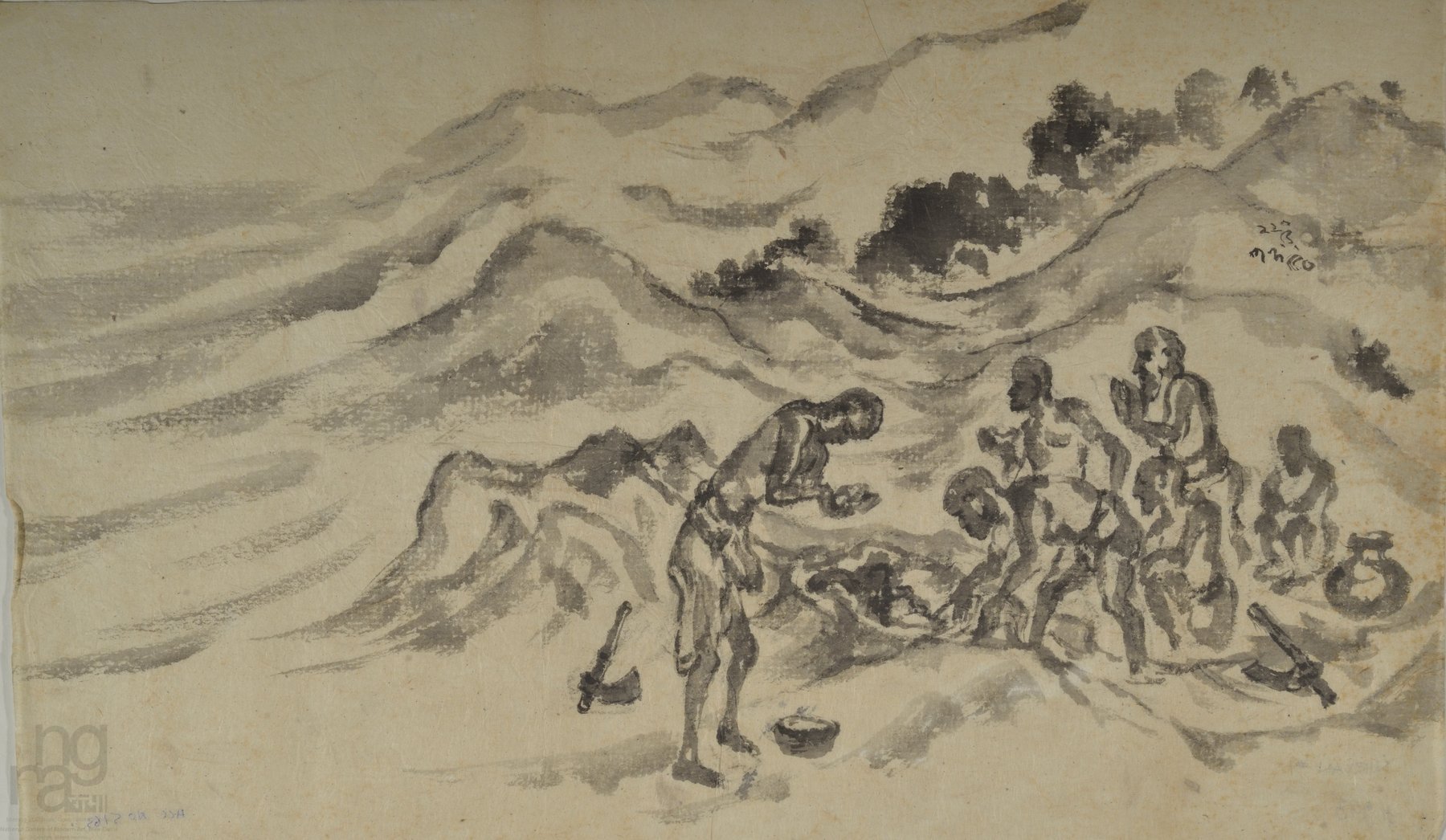
| Title | NIRVAN-I |
|---|---|
| Accession Number | ngma-05163 |
| Museum Name | National Gallery of Modern Art, New Delhi |
| Gallery Name | NGMA-New Delhi |
| Object Type | Painting |
| Medium | Watercolour on Sumi paper |
| Main Artist | Nandalal Bose (1882-1966) |
| Artist's Nationality | Indian |
| Artist's Life Date / Bio Data |
Nandalal Bose, popularly known as the Master Moshai, was born on December 3rd, 1882 in Kharagpur, Monghyr District, Bihar. A disciple of Abanindranath Tagore, he graduated from Government School of Art, Calcutta in 1910. Nandalal was fascinated by the potential of folk art and indigenous modes of expression and inculcated them in his works although stylising them in a unique representation for depiction and narration of local life. His explorative temperament with artistic materials allowed him to create a vast body of work with printmaking techniques such as lithography, linoleum prints and Sino-Japanese techniques while remaining faithful to his narrative subject: India's environment and its ethos. Nandalal Bose's art conjures newness unbound, yet it is flushed with the memories of yesterday. Inspired by Far Eastern sensibilities that celebrate the traditional, the genius of his art lies in the interplay of sensual silhouettes and his powerful rendering of contemporary themes with the traditions, customs and sensibilities of Indian heritage. It is this intermingling that invigorates his works and captures the minds of his viewers. He began his artistic career in the fervour of the Swadeshi movement, rejecting western colonial norms of art and taking inspiration from the ancient murals of Ajanta and Bagh caves as well as Mughal miniatures. In 1919, Nandalal Bose accepted Rabindranath Tagore's invitation to become the Principal of the newly established art school Kala Bhavan at Visvabharati University in Santiniketan. He travelled in and out of India including places like Burma, China, Japan, Malaysia, Java and Sri Lanka seeking artistic stimulus from observing different cultural traditions. He also painted a series of posters for the Indian National Congress at Haripura in February 1938. The range of Nandalal's artistic expression is seen in his various landscapes with human figures, his varied images of nature and the Santiniketan Murals. His works reflect the changing landscape, portraying people and places at a time when modern India's cultural development was at its threshold. Nandalal Bose died on April 16th, 1966 in Santiniketan, West Bengal. He won several accolades including the Padma Vibhushan by the President of India in 1953. He was awarded with an honorary Doctorate in Letters (D. Litt.) from Banaras Hindu University in 1950 and Calcutta University in 1957. The NGMA has over 6800 of his works in its collection. |
| Origin Place | India |
| Period / Year of Work | 1950 |
| Inscription | Dated '22.5.50' and signed 'Nanda' in Bengali vertically in the top-right corner of the painting with brush in black colour. The painting also bears the artist's personal seal in red. |
| Dimensions | 51.7 x 31 cms |
| Brief Description | This painting belongs to a series of monochromatic ink and watercolour paintings inspired by the Sumi-e Japanese technique the artist employed in the last phase of his life. These compositions were stripped to the bare minimum where only a few strokes of ink were employed to create natural forms in an effortless approach. The above painting belongs to the 'Nirvan -I' series. The artist has executed a scene of Nirvan, with a range of strokes in tonal variations capturing the rhythm and pattern of the image. This painting was purchased from the collection of Shri Biswaroop Bose and Smt. Nivedita Bose, children of Nandalal Bose. |
| Detailed Description | Nandalal had a firm belief that for the creation of art an intimate understanding of nature and its way is imperative. Nandalal often sought to convey the harmony and even unity between human beings and nature, often using ink wash techniques learned from Chinese and Japanese traditions. In his book,' Vision and Creation', Nandalal elaborates, "The main difference between Indian and Chinese art traditions is in that the Chinese artist considers himself a part of nature and tries to lose himself within it, and the Indian artist, knowing that both he and nature are moved by the same life rhythm, takes nature for another expression or image of his own being." |


