
A Sketch from Album No 64
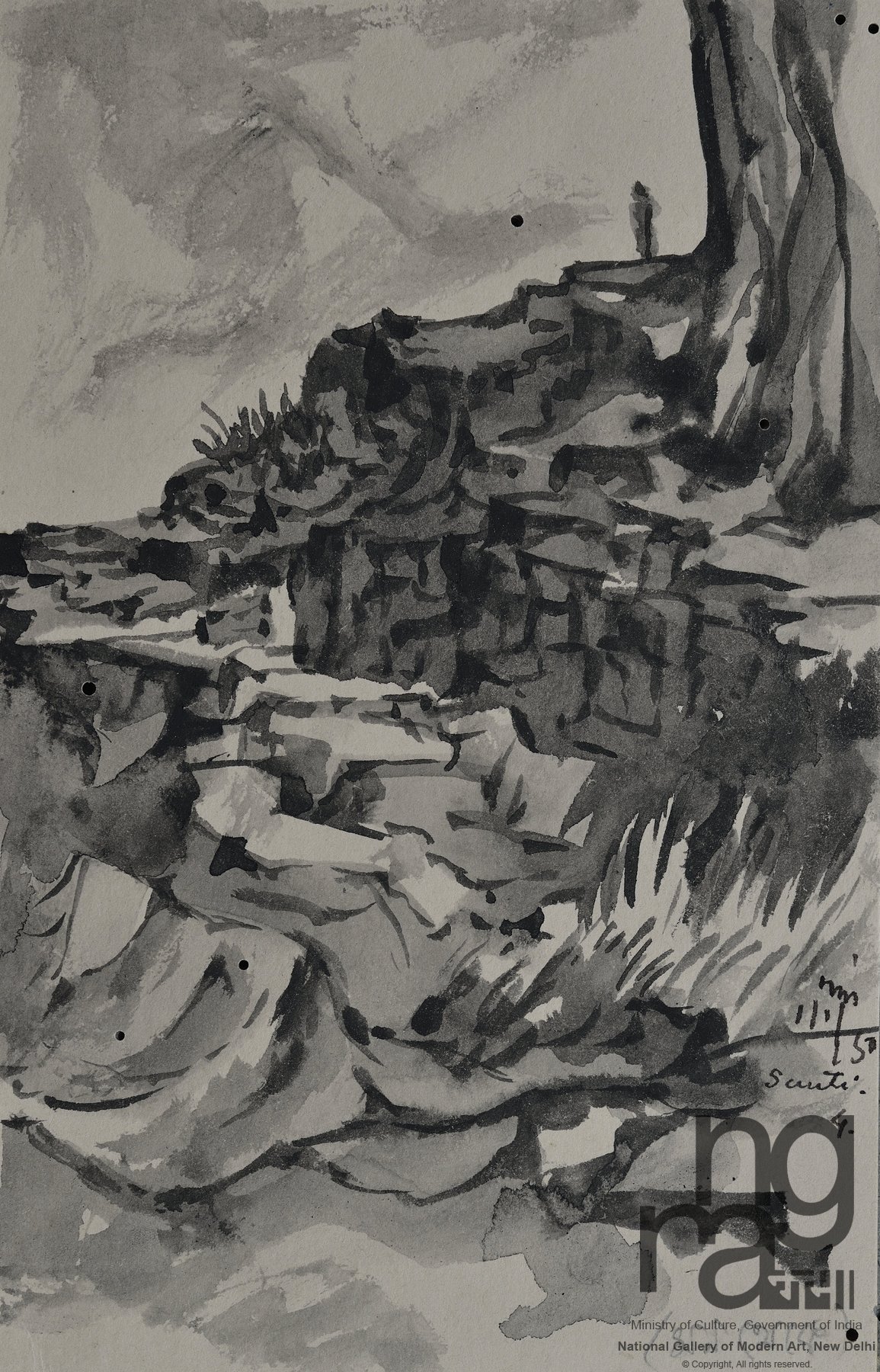
| Title | A Sketch from Album No 64 |
|---|---|
| Accession Number | ngma-08666 |
| Museum Name | National Gallery of Modern Art, New Delhi |
| Gallery Name | NGMA-New Delhi |
| Object Type | Painting |
| Main Material | Watercolour on postcard |
| Main Artist | Nandalal Bose (1882-1966) |
| Artist's Nationality | Indian |
| Artist's Life Date / Bio Data | Nandalal Bose, popularly known as the Master Moshai, was born on December 3rd, 1882 in Kharagpur, Monghyr District, Bihar. A disciple of Abanindranath Tagore, he graduated from Government School of Art, Calcutta in 1910. Nandalal was fascinated by the potential of folk art and indigenous modes of expression and inculcated them in his works although stylising them in a unique representation for depiction and narration of local life. His explorative temperament with the artistic materials allowed him to create a vast body of work with printmaking techniques as lithography, linoleum prints and Sino- Japanese techniques while remaining faithful to his narrative subject: India's environment and its ethos. Nandalal Bose's art conjures newness unbound but still flushed with the memories of yesterday. Inspired by Far Eastern sensibilities that celebrate the traditional, the genius of his art's lies in the interplay of sensual silhouettes and his powerful rendering of contemporary themes with the traditions, customs and sensibilities of Indian heritage. It is this intermingling that invigorates his works and captures the minds of his viewers. He began his artistic career in the fervour of Swadeshi movement, rejecting western colonial norms of art and taking inspirations from the ancient murals of Ajanta and Bagh caves as well as Mughal miniatures. In 1919, Nandalal Bose accepted Rabindranath Tagore's invitation to become the Principal of the newly established art school Kala Bhavan at Visvabharati University in Santiniketan. He travelled in and out of India including places like Burma, China, Japan, Malaysia, Java and Sri Lanka seeking artistic stimulus from observing different cultural traditions. He also painted a series of posters for the Indian National Congress at Haripura in February 1938. The range of Nandalal's artistic expressions is seen in his various landscapes with human figures, his varied images of nature and the Santiniketan Murals. His works reflect the changing landscape, portraying people and places at a time when modern India's cultural development was at its threshold. Nandalal Bose died on April 16th, 1966 in Santiniketan, West Bengal. He won several accolades including the Padma Vibhushan by the President of India in 1953. He was awarded with an honorary Doctorate in Letters (D. Litt.) from Banaras Hindu University in 1950 and Calcutta University in 1957. The NGMA has over 6800 of his works in its collection. |
| Country | India |
| Period / Year of Work | 01.01.1950 |
| Inscription | Signed 'Nanda' in Bengali and dated '1/1/50' in English at the bottom right corner of the painting with brush and black colour. The painting also bears an inscription which reads 'Santi' in English, referring to Santiniketan. The painting bears another inscription in Bengali, translated as 'Rajgriha (From memory)' with pencil. |
| Dimensions | 8.8 X 14 cms |
| Brief Description | Nandalal Bose also mastered the Sino- Japanese techniques of painting being first influenced by Okakura Kakuzo and the train of Japanese artists who visited India after him especially Arai Kampo. The blurring of the linear outlines of figures and the harmonious dilution of colours were techniques Nandalal acquired from the arts of the Far East. In the above painting, Nandalal uses a series of diverse tones and brush strokes to illustrate a rocky, trodden mountain path from his memory. A figure of a human standing on the cliff is suggested with a small blot of colour. The adept use of the inherent white space and slight shade differences in the intensity of a single black colour showcases Nandalal's prowess in the art of monochromatic painting. |
| Detailed Description | National Gallery of Modern Art, New Delhi acquired the largest collection of 6744 artworks of Nandalal Bose from his family, some of which were exhibited in the Centenary exhibition organised by the museum in the year 1983. A major portion of the museum's collection includes monochromatic pencil sketches, pen and ink drawings on postcard and paper, watercolour paintings and sketches apart from the more detailed and elaborate tempera and wash paintings, Haripura posters and prints from the artist's extensive oeuvre. Dinkar Kowshik in his article 'Drawings and Sketches of Nandalal in the book, "Nandalal Bose - A collection of Essays" has elucidated about the sketches of Nandalal in the words "Much of his (Nandalal) strength and sensitive wealth finds expression in the spontaneity of his sketches. They are a veritable treasure of shrewd observation, powerful calligraphy, psychological insight, rich sallies of humour and emphatic portrayal of the flora and fauna." |


