| Artist's Life Date / Bio Data |
Francis Newton Souza was born in Saligaon, Goa on April 12th, 1924. He got his Diploma in Painting from Sir J. J. School of art, Mumbai in 1945. He also went to Italy on a study tour under the Italian government scholarship through the British Council in 1960. Post India's independence, he founded the Progressive Artists' Group, a group of artists formed in resistance to academic art prevalent during that time, along with other artists- M. F. Husain, S. H. Raza, K. H. Ara, S. Bakre and H. A. Gade and became its spokesperson in 1947. He was deeply inspired by the Modernists of the West, religious paintings of the Church as well as the folk paintings of Goa.
Famous for his blunt and satirical style, F. N. Souza moved to London in 1949 to gain recognition in his artistic pursuit. After a period of struggle, he finally got successful in his endeavours with his solo show in Gallery One in London in 1955. During this time, he also published his autobiographical essay 'Nirvana of a Maggot'.
Thereafter, in 1969, he moved to settle in New York where he lived till he passed away in 2002. He received several accolades during his lifetime including the prestigious Guggenheim International Award in 1969. he was also honoured with John Moores Prize, Liverpool in 1957and 1998 Kalidas Sanman by the Government of Madhya Pradesh, India in 1998. |
| Brief Description |
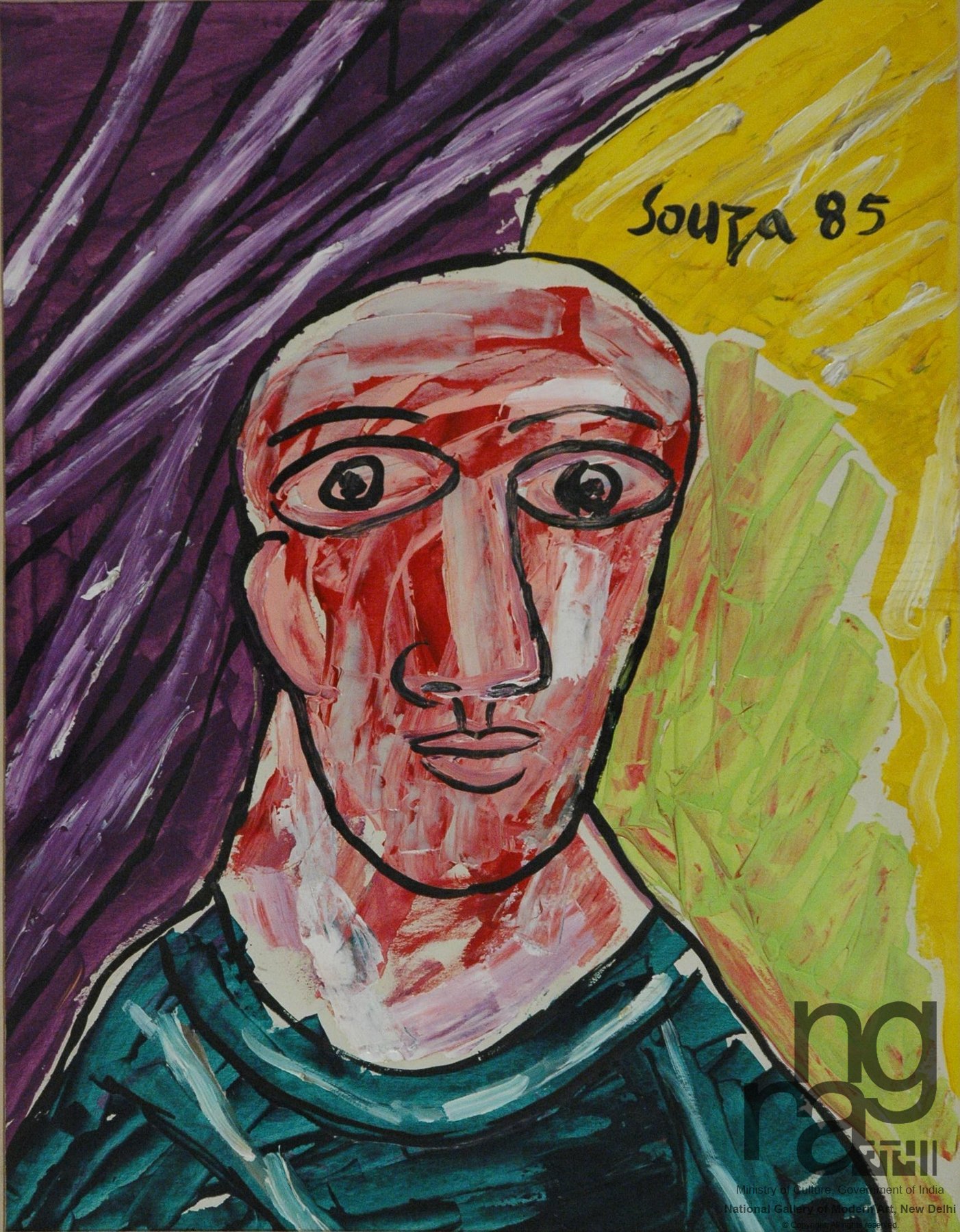
Bold eyes stare out, just a few black strokes give the sense of a strong personality – swathes of energetic red, purple, yellow and blue fit together like a jigsaw puzzle. You are looking at a self portrait by Francis Newton Souza, painted in his distinctive, emotive style. Souza’s unique form combined impressionism and expressionism with the spirit of cubism and the sculptures of classical Indian tradition. His work covered a range of subjects from Catholic Christian iconography -- that stemmed from his Goan Catholic roots -- to nudes, still life and landscapes.
Souza’s work passed through various phases from the early days in Mumbai to a period of struggle, success and turmoil in London to international recognition and a more stable life in New York. But in every phase Souza’s art was invariably bold and exploratory. It was often dark, brutal and aggressive, but also erotic, sensual and touched with an ironic humour.
Souza was a founder member of the influential Progressive Artists Group that included SH Raza and MF Husain and heralded a truly modern approach in Indian art. He died in Mumbai in 2002 at the age of 78.
|