Meera Mukherjee was born in Calcutta in 1923. At the young age of 14 she started taking art classes at the Indian Society of Oriental Art, she then joined the Delhi Polytechnic in 1947. For a while she worked under the noted Indonesian painter Effendi in Shantiniketan. Meera went to Germany in 1953 to study painting at the Hochschule fur Bildende Kuenste in Munich but soon switched to Sculpture and returned to India in 1956.
Meera was interested in traditional and folk metal casting techniques - she has been researching on various metal casting techniques since 1960. She held her first show in 1960 and has used many methods like the cire perdu or lost wax process for her sculptures.
She has been honoured with the Padma Shri, the President's Award of Master Craftsman, and the Abanindranath Award from the West Bengal Government.
Country
India
Dimensions
Length:84 Width:31.5 Height:172 centimeter
Brief Description
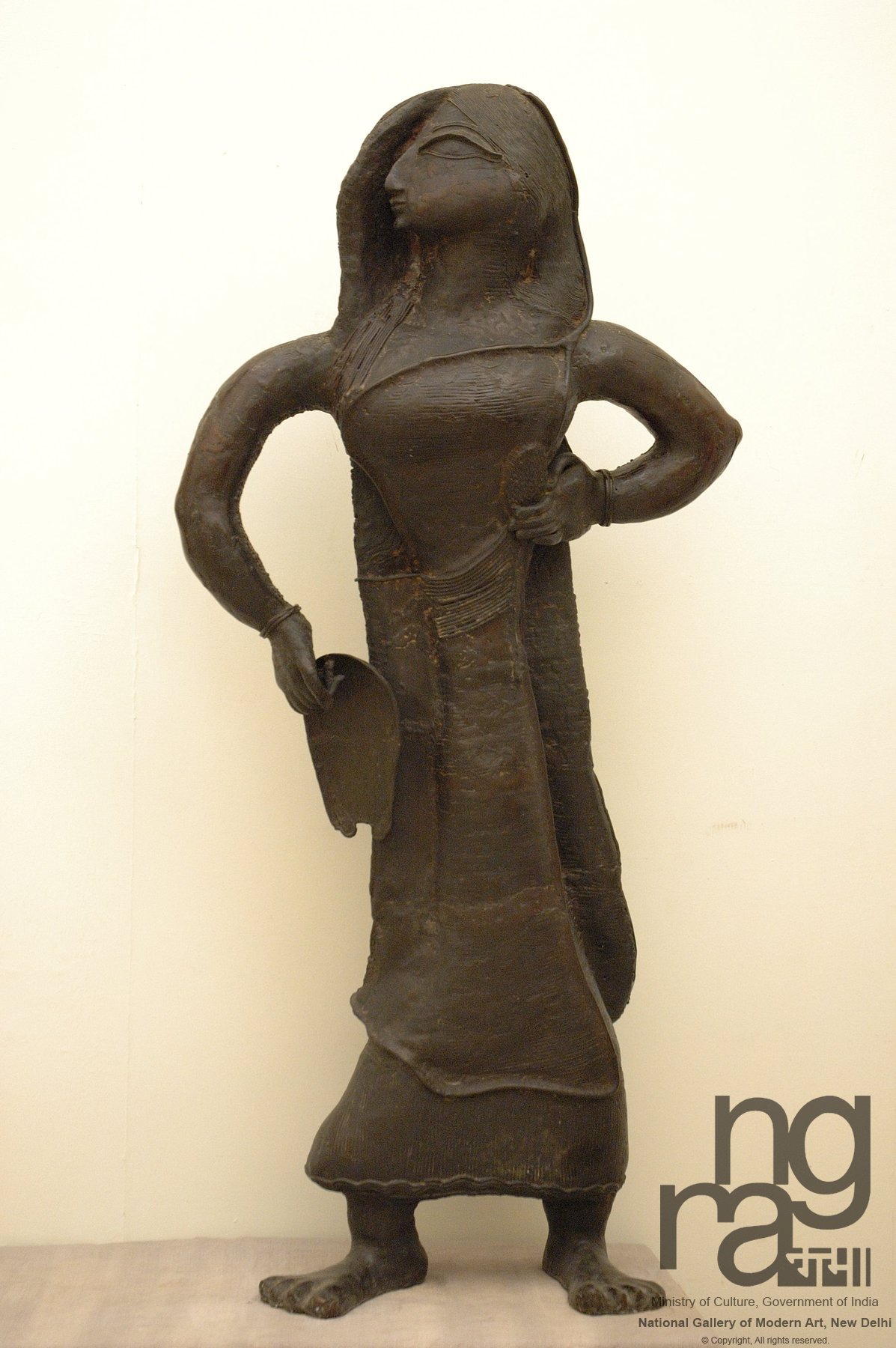
Woman feet are spread and firmly planted on the ground, her partially covered head is held high. She holds a winnow lightly in her right hand. Sculptor Meera Mukherjee was deeply influenced by the dhokra craft of the tribal people of Bastar and the elongated body, the rounded limbs and the stylized features of this woman remind us of the unique craft. Born in Kolkata in 1923, Mukherjee began her art training at the age of 14, first in her hometown and then in Delhi and later in Munich.
She worked with the tribal sculptors of Bastar after she returned from Europe and learnt from them the lost wax method or cire perdue. In this process a form is sculpted in wax and encased with clay. The wax is then replaced with molten metal. Mukherjee used it to develop her own distinctive method of bronze casting.Many of her sculptures are of common men and women going about their daily chores like this woman.
The works are simplistic yet sophisticated, modern and full of vitality. Mukherjee’s sculptures are valued possessions of museums and private collectors across the world. A recipient of the Padma Shri, she passed away in 1998. In spirit of daily work she celebrates the humanism and compassion for female identity.