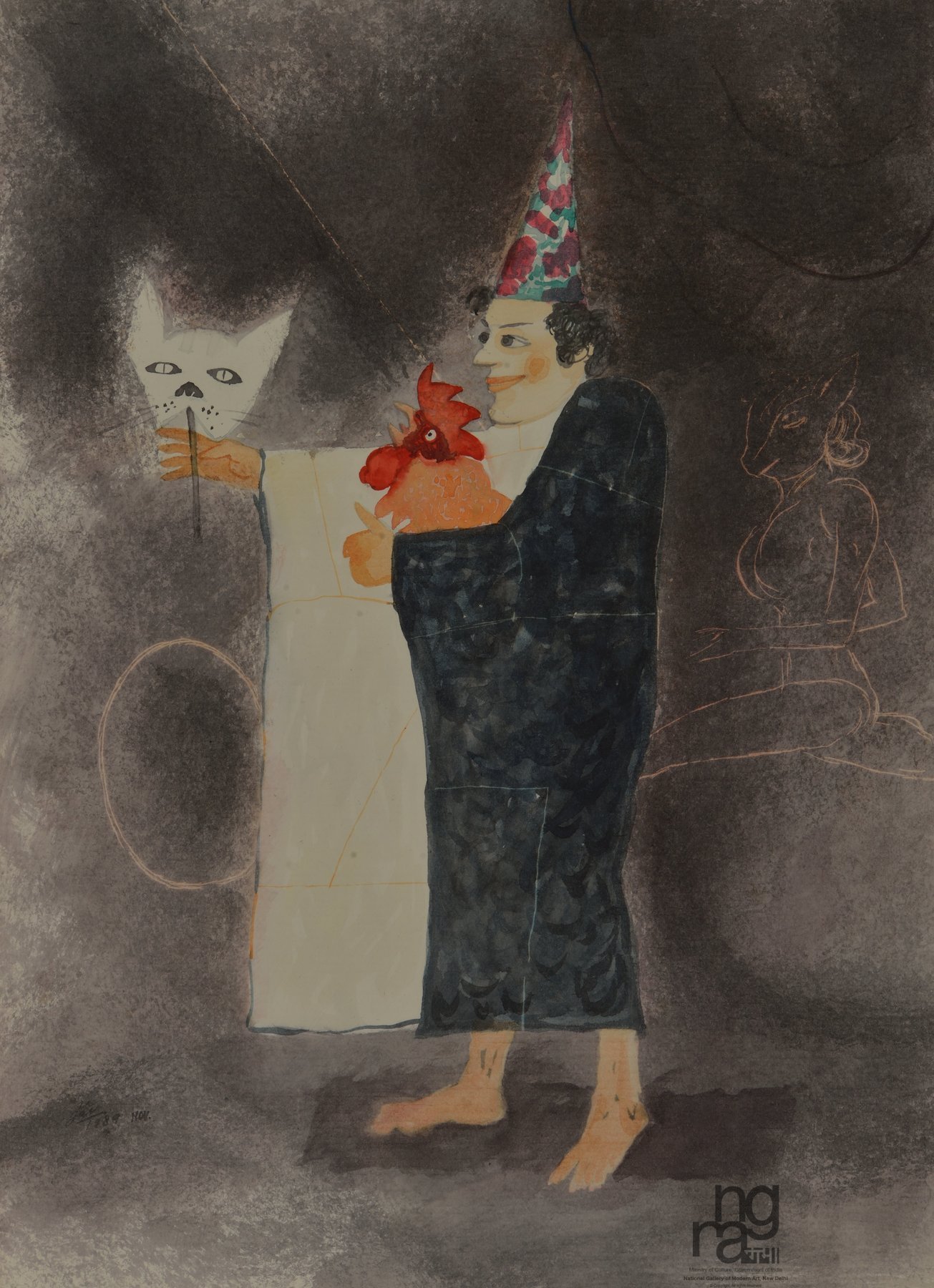
The visuals structure in Zharotia's works have been compared to Japanese Haikus, with his sparse use of figures on flat color surfaces equivalent to the musical notes that hang isolated in the space. His works, like those of the western expressionists as Jean Miro and Paul Klee have a playful element with a softness of painted forms and playful placement of human, animate and inanimate objects in his compositions create a childlike curiosity while viewing his paintings.
But even in the presence of this playful element his works have strong suggestion to the society like a dismantled idea of power and authority attributed to masculinity. The duality of life and the imagined life, that is the experience and the imagination can be seen reflected in his works.
His paintings one can see unusual spaces, almost surreal which are much beyond the common places we see around. The play of light and shadow that can be seen in his works is also not confined to any physical laws, much like the subjects of his paintings.