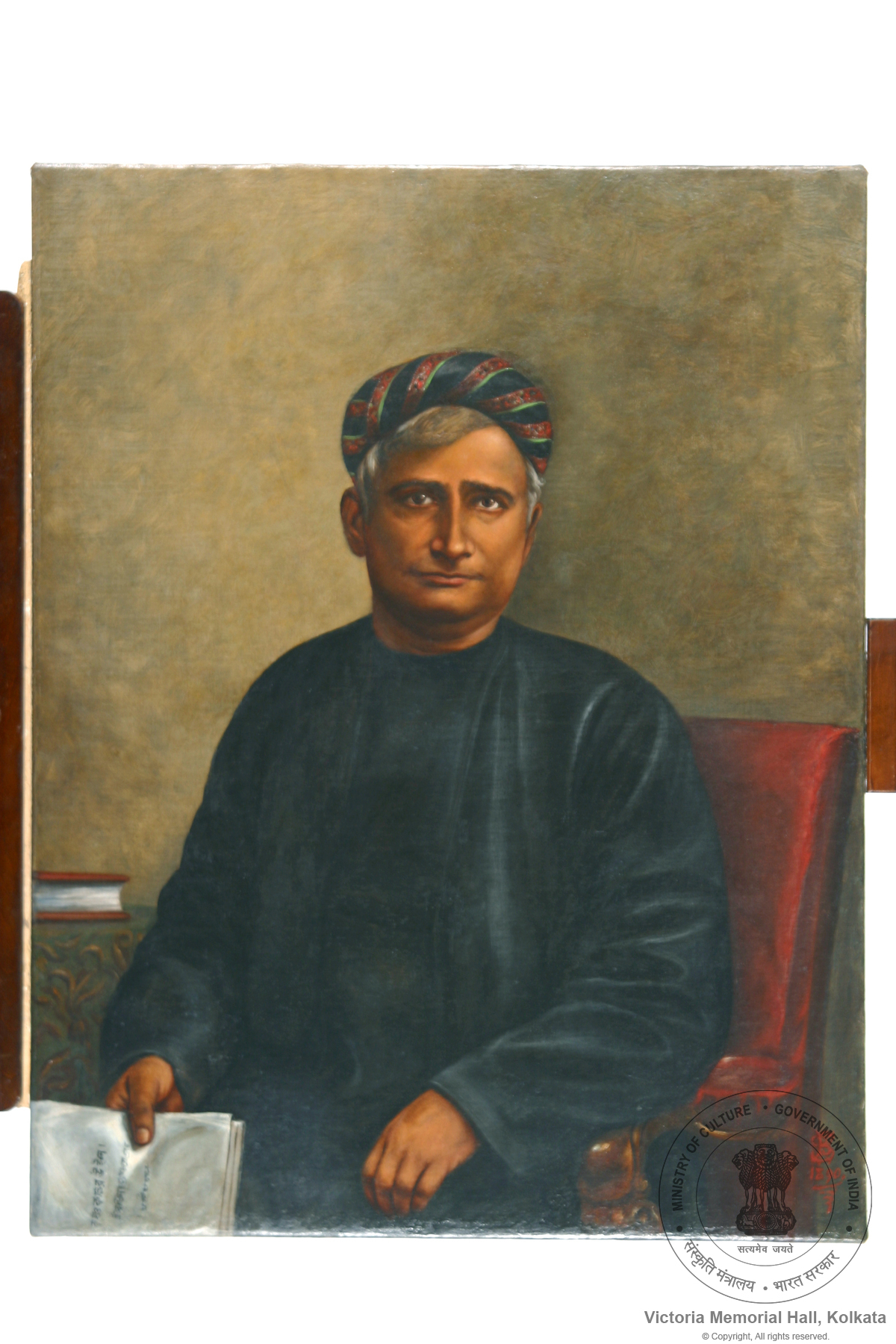
| Artist's Life Date / Bio Data |
(1851-1932) He received his initial training in painting at the Calcutta Art School, took private lessons with Pramathalal Mitra. Subsequently, he worked as an apprentice to the German painter Karl Becker who was then living in Calcutta. He received a prize in an exhibition organized by the Society for the Promotion of Industrial Art in 1879. From 1880 to 1884 he did commissions in Allahabad and Lahore.
His popularity rests on his paintings illustrating Hindu mythology. He was deeply influenced by the genres of European history painting. Though a junior contemporary of Ravi Varma, the most influential artist of the time, Bamapada evolved an individual style and dominated the popular taste for decades through reproductions of his works, most of which were printed in Germany. |
| Brief Description |
Babu Bankim Chandra Chattopadhyay (1838-1894). One of the two who graduated from the Calcutta University at the first B. A. examination of that University held in 1858, he was appointed a Deputy Magistrate which post he held till 1892. He was a prolific writer of Bengali prose, and Bengali literature is deeply indebted to him. He wrote several novels on historical subjects as well as social topics. Some of his essays freely criticised contemporary society. He wrote the first Bengali historical novel Durgeshnandini in 1865 which was followed by Kapalkundala, Mrinalini, Bishabriksha, Krishnakanter Will, Debi Chaudhurini etc. He won for Bengali novel recognition as a work of superb literary art.
He also wrote on religious, philosophical and other subjects including humorous sketches of which Kamalkanter Daptar is the best specimen. His writings showed deep love of his motherland and its culture. In 1872 he brought out Bangadarshan, a monthly journal, whose publication marked the beginning of a new era in the history of Bengali culture and literature. For Anandamath, his novel on the Sannyasi rebellion, he composed the inspiring poem Bande Mataram which is now a national song of India.
A staunch champion of Indian culture and nationalism, Bankim duly appreciated the value of Western philosophy and teachings of science. His grateful countrymen remember him today not only for his unique contribution to language, literature and philosophy but also as the high priest of Indian nationalism and the composer of the inspiring Bande Mataram song.
|