
Mahatma Gandhi
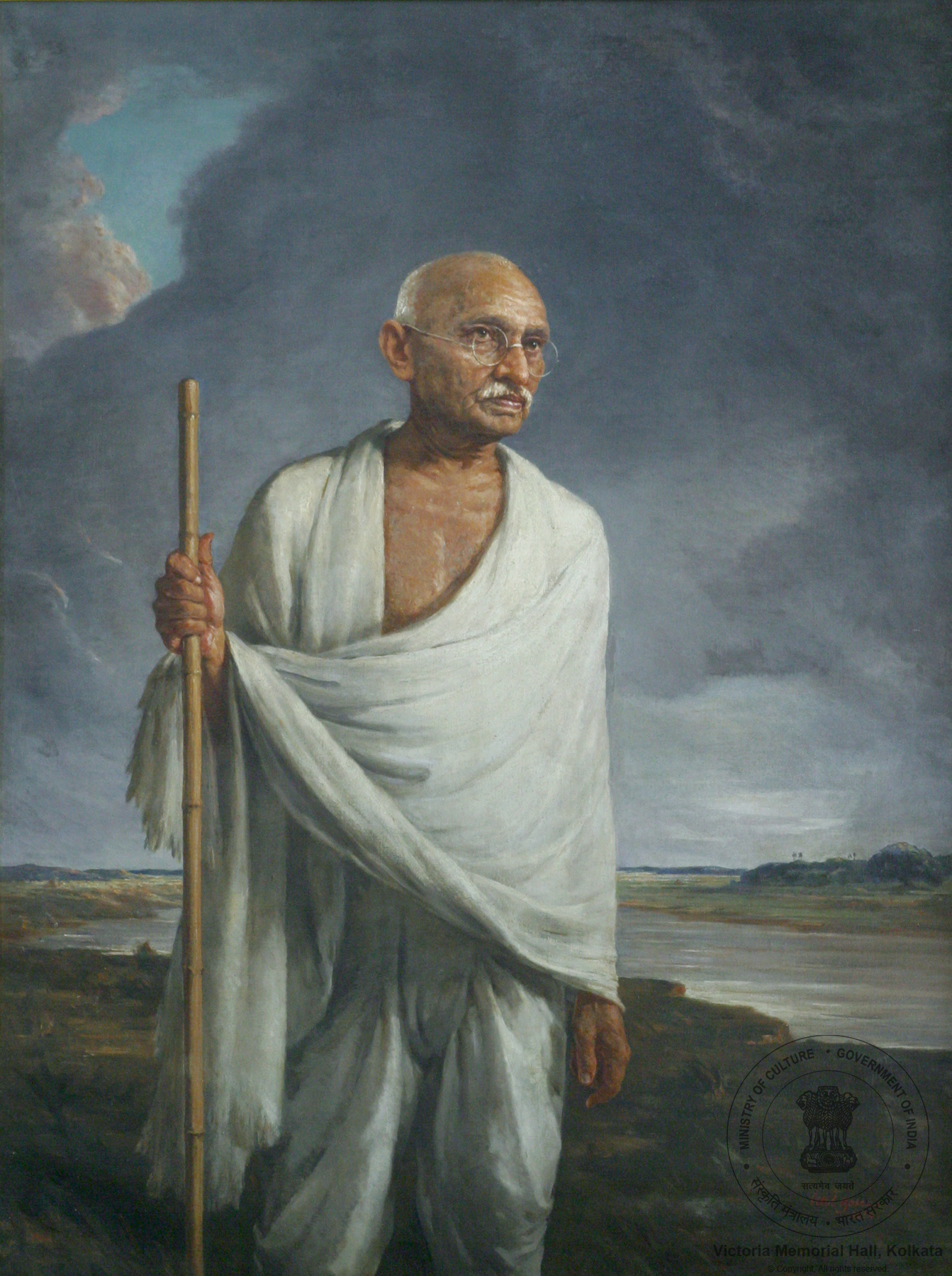
| Title | Mahatma Gandhi |
|---|---|
| Accession Number | R3017 |
| Museum Name | Victoria Memorial Hall, Kolkata |
| Gallery Name | NA |
| Object Type | Painting |
| Medium | Oil on Canvas |
| Main Artist | Atul Bose |
| Artist's Nationality | Indian |
| Artist's Life Date / Bio Data | (1898-1977) Atul Bose was a portrait painter from Bengal, studied at the Jubilee Academy in Calcutta and then at the Government art school. Bose spent two years, 1924-6, at the Royal Academy. He was deeply influenced there by Walter Sickert. Upon his return to India, Bose taught at the Government art school in Calcutta. In 1929, the Government of India announced an all-India competition to produce copies of the royal portraits at Windsor Castle for the Viceroy's new residence in New Delhi. |
| Provenance | The Trustees of Victoria Memorial |
| Origin Place | Mymmensing, Dacca |
| Style | Academic European Style |
| Dimensions | 152.4 x 114.2 cm |
| Brief Description | Mahatma Gandhi, (Mohandas Karamchand Gandhi, 1869-1948) Better known as a father of the nation, he came of a family of devout Vaishnavas settled in Porbandar. On completeing the course at the Inner Temple, London, he started practice at Bombay and then at Rajkot. soon after he left for South Africa to represent an Indian firm in a law-suit. there he sensed the oppressive atmosphere of racial hatred and social injustice in which the Indian and coloured peoples had to live. He had gone on a temporary assignment, but he lived there for 20 years, except for two brief spells of stay in India. He led a movement of Passive Resistance against the Black Acts of the Governments of Natal and Transvaal. He was imprisoned several times. The Government of General Smuts was compelled, in the end, to concede the main Indian demands. On return to India in 1915 Gandhiji founded, on the outskirts of Ahmedabad, on the Sabarmati, the Satyagraha Ashram. soon after he caused a stir by leading Satyagraha movement at Champaran in Bihar on behalf of the exploited peasants. His next field of activity was Ahmedabad where he led a pieceful movement on behalf of the textile mill workers, Kheda district in Gujarat then saw his programme of non-violent resistance in action. the denial of civil liberties proposed by the British Government through the Rowlatt Bill brought Gandhiji into the stage of All-Indian politics. He gave a call for peaceful hartal to which the whole country responded. The Jalianwalla Bag massacre roused the entire country to indignant protest. The Congress, now dominated by him, initiated a movement of non-cooperation (1920) to which Hindus and Muslims alike responded. The British Government brought forth its armoury of repression. Men and women, in thousands, courted imprisonment. Gandhiji himself was sentenced to six years term of prison. The next phase of freedom movement was sparked off by Gandhiji's historic Dandi March. The Government of Lord Irwin concluded a pact and persuaded the nation's leader to attend the second Round Table Conference. But soon after it reverted to the old method of repression. Gandhiji returned empty-handed from London to find himself once again ladged in jail. While in prison, he undertook a fast unto death in protest against the British move to introduce the principle of separate electorate not only for the Muslims but for the 'untouchables' as well. The Government modified the plan. For the next several years Gandhiji kept himself engaged in village work, work for the Harijans and for Hindu-Muslim unity. The outbreak of World War II brought him back to active politics. In August 1942 he called upon the British to quit India and let India defend herself, and prepared to lead a country-wide Satyagraha. Gandhiji, once again, was put in jail. The worsened the situation; for the people, deprived of sober leadership, rose up in sporadic disorder. In the days after World War II communal frenzy was at its worst in Noakhali and Bihar. Gandhiji, aged 77, went from village to village in a heroic effort to restore sanity and tolerance. In august 1947 Gandhiji was in Calcutta, then in the throes of communal passion. In September he went to Delhi where the communal passion. In September he went to Delhi where the communal disorder had in the meantime spread. The fury subsided, but a cruel fate awaited the apostle of non-violence. On January 30, 1948, while on the way to prayer meeting, he fell at the hands of an assassin. His martyrdom is his last and the most enduring gift to humanity. |


