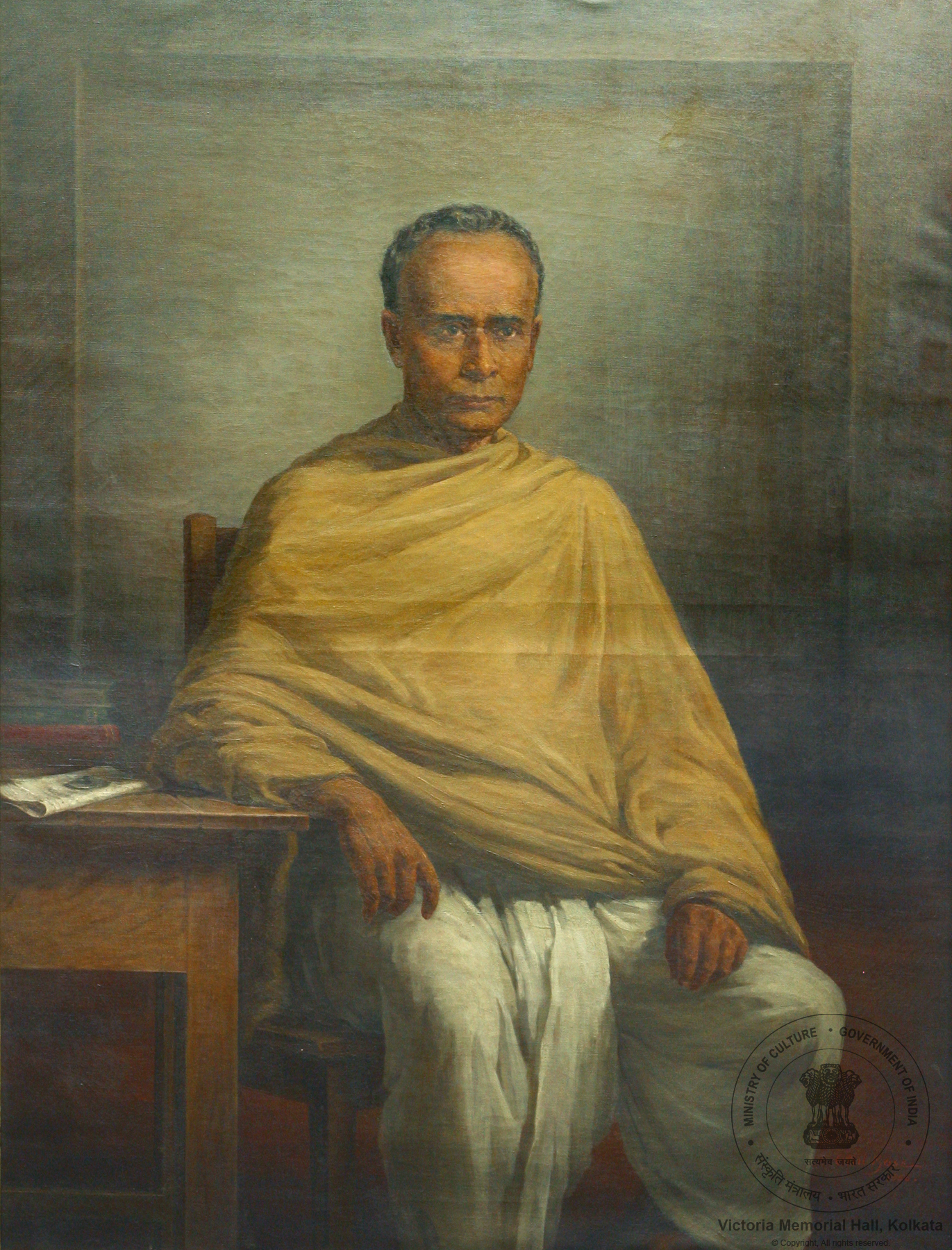
| Artist's Life Date / Bio Data |
(1898-1977) Atul Bose was a portrait painter from Bengal, studied at the Jubilee Academy in Calcutta and then at the Government art school.His Bengal Tiger, a sketch of Asutosh Mukherjee, earned him a scholarship to the Royal Academy in London. Bose spent two years, 1924-6, at the Royal Academy. He was deeply influenced there by Walter Sickert.
Upon his return to India, Bose taught at the Government art school in Calcutta. In 1929, the Government of India announced an all-India competition to produce copies of the royal portraits at Windsor Castle for the Viceroy's new residence in New Delhi. |
| Brief Description |
Iswar Chandra Vidyasagar (1820-1891) As a student of the Sanskrit College, Calcutta, he qualified in different branches of Sanskrit learning and obtained the title of 'Vidyasagar'. In 1841 he was appointed Head Pandit, Fort William College, Calcutta. In 1850 he became a professor in the Sanskrit College, Calcutta and next year became its Principal. Later as Special Inspector of Schools, he set up model schools in the districts and also school for girls. He carried on movement for the re-marriages of Hindu widows which led to the enactment of law in 1856 legalising such re-marriage. He also fought against polygamy and other social evils in Hindu society.
He resigned Government service in 1858 and devoted himself to writing books in Bengali. author of nearly 25 Bengali books, he is called the father of modern Bengali prose. his books for beginners in Bengali have educated generations of children. He collaborated with Bethune in founding the Hindu Female School (later known as Bethune School) for girls. He also founded the Metropolitan Institution, later re-named after him.
A man of iron will, he was the embodiment of discipline. Charitably disposed, he gave away whatever he earned for the relief of the distressed. By virtue of his service to education, his humanism and manliness, and his efforts for improvement of the condition of women Vidyasagar is esteemed as one of the makers of modern India.
|