
Dr Bidhan Chandra Roy
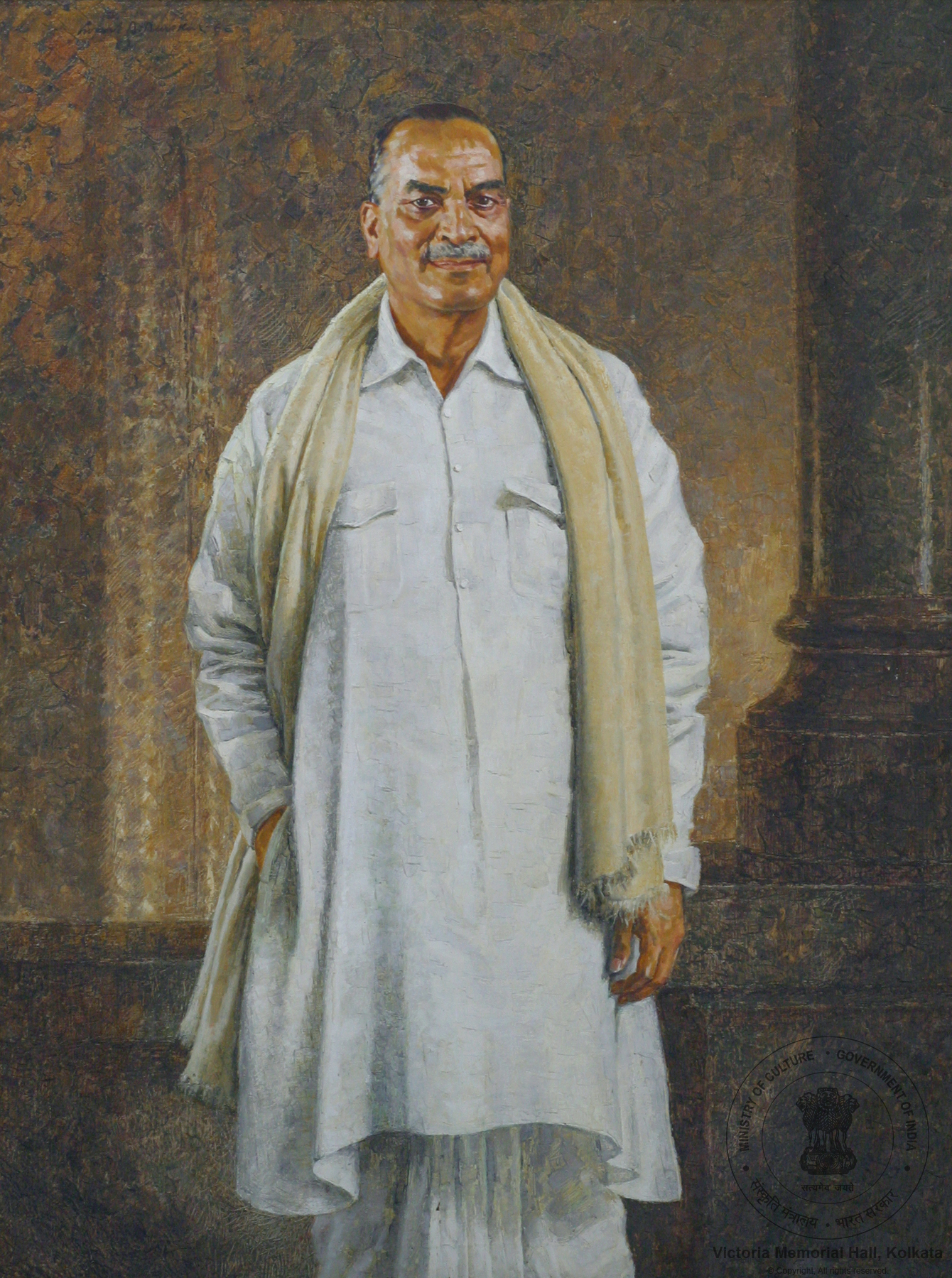
| Title | Dr Bidhan Chandra Roy |
|---|---|
| Accession Number | R3178 |
| Museum Name | Victoria Memorial Hall, Kolkata |
| Gallery Name | NA |
| Object Type | Painting |
| Medium | Oil on Canvas |
| Main Artist | Gopal Damodar Deuskar |
| Artist's Nationality | Indian |
| Artist's Life Date / Bio Data | (1911- 1994)- Gopal Damodar Deuskar was born in 1911 in Ahmednagar. He studied at the Sir J.J. School of Art. He was a recipient of several prizes during the course of his career. He received specialised training at the Art Academies of Paris, Vienna, Madrid and Berlin. He also exhibited at the Royal Academy, London. He became Deputy Director of the Sir J.J. School of Art on his return to India. He resigned from his job to pursue painting and developed himself to be a professional portrait painter. He painted portraits of members of India's royal families and eminent industrialists in the course of his career. He was also commissioned by the Government to paint portraits of leaders as also murals for public buildings. Gopal Deuskar passed away in 1994. |
| Provenance | Prepared by the Trustees of Victoria Memorial |
| Origin Place | Ahmednagar |
| Style | British Academic style |
| Period / Year of Work | 1968 |
| Inscription | Signed Gopal D Deuskar with date 68 in upper left corner |
| Dimensions | 152.4 x 114.2 cm |
| Brief Description | Dr. Bidhan Chandra Roy (1882-1962) After completing B. A. at Patna where he received his early education, he joined the Calcutta Medical College in 1901. On graduation he became an Assistant Surgeon (1906) and M.D. in 1908. Next he sailed for England, and qualified for both the M.R.C.P. and the F.R.C.S. (1911). In the former he came out first. On return he served for some years as a teacher of the Campbell Medical school. In 1919 Dr. Roy joined the Carmichael Medical College as Professor of Medicine, 1923 saw him enter the wider field of politics and public service, through winning a contest for a Legislative Council seat against the veteran politician- Sir Surendranath Banerjee. Later he joined the Swarajya Party of Deshbandhu C. R. Das and became its Deputy Leader. He acted as General Secretary, Reception committee of the Calcutta session of the Indian National Congress (1928). In 1930, while a member of the Congress Working Committee, he was sentenced to six months term of prison. In 1931-32 he was elected Mayor of Calcutta. For the next 12 years he remained mainly engaged with his profession in which he was unrivalled in this country, with a spell of Vice-Chancellorship of the Calcutta University (1941-44). In January 1948 Dr. Roy became the Chief Minister of West Bengal, an office he held with distinction till his death. In 1961 he was awarded Bharat-Ratna, the highest honour in the gift of the government of India. His public activities as President of All India Medical Council, Trustees of Chittaranjan Sevasadan, President, Council of the National Education, Jadavpore, and above all, as Chief Minister, reveal alike his bold imaginative insight and extraordinary organising capacity. |


