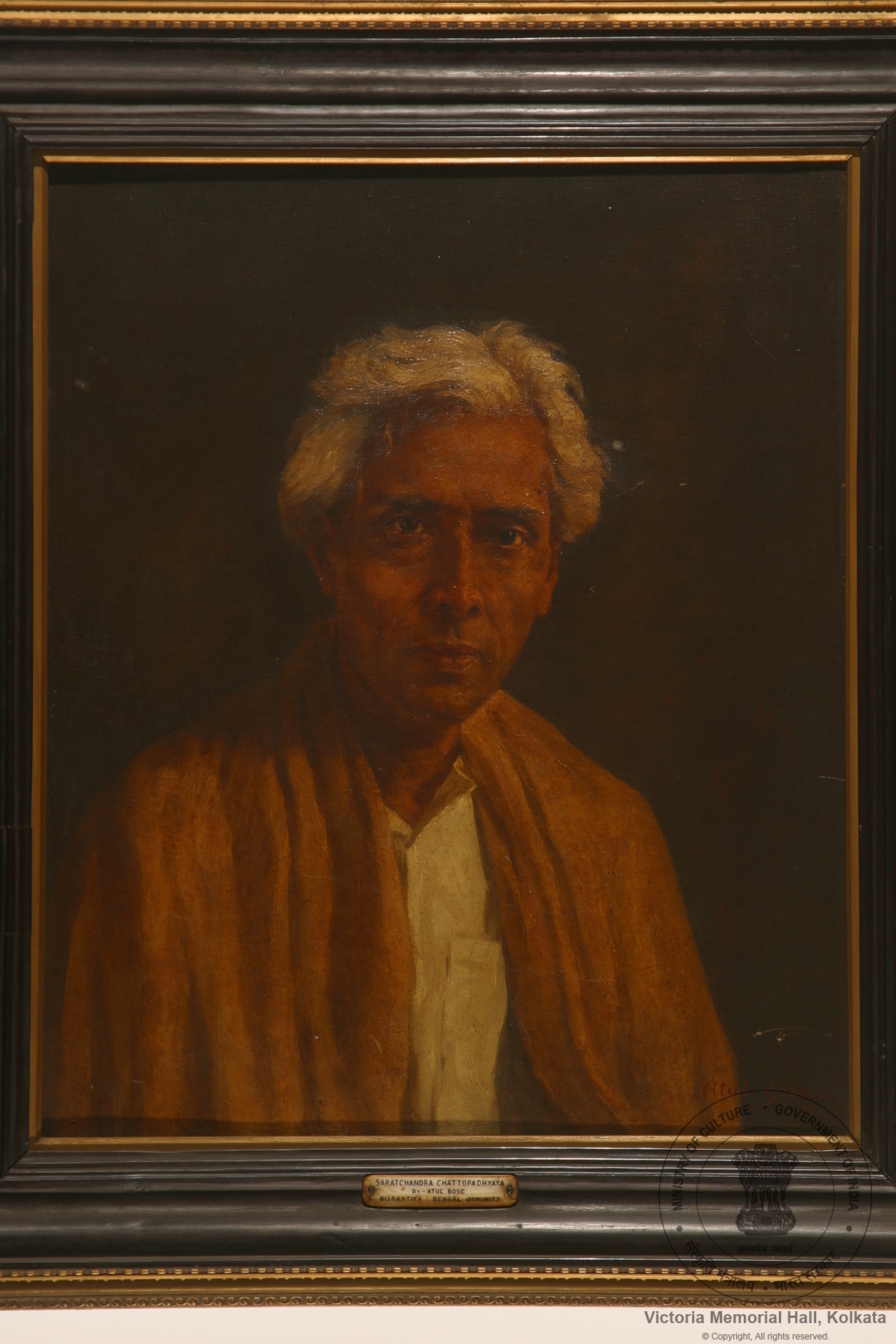
| Brief Description |
Saratchandra Chattopadhyay was born on September 15, 1876 at Devanandapur in the Hooghly district of West Bengal.He spent most of his childhood with his mother at her family's home in Bhagalpur, Bihar, from where he passed the University Entrance examination. At the age of 27 he went to Burma and found a job as a clerk in a government office at Rangoon. He left Rangoon in 1916 and settled, first at Baje Shibpur, Howrah, near Kolkata. And then, about ten years later, he moved to his own house in Samtabed, a village on the banks of the Rupnarayan. Some time before his death he had built another house in Calcutta. He died in Calcutta on January 16, 1938.His first short story was published in 1903 under his uncle's name Surendranath Ganguli. Baradidi, a novella, rather a long short-story, was published in 1907, now under his own name, in Bharati. While in Burma, he continued revising the drafts of many of his writings that he had first penned down at Bhagalpur, at the same time he worked on creating new fiction.
Indeed, some of the most endearing characters he created, namely "Indranath" of Srikanta (1917), or "Lalu" of Chhelebelar Galpa(published as a book three months after his death in 1938) were based on his friend Rajendranath Majumdar or Raju of Bhagalpur. Since 1913, and particularly after 1916, Saratchandra's fame has been firmly established. He has been an extremely popular author ever since. Among his novels are Devdas (written in 1901 but published in 1917), Parineeta (1914), Biraj Bou (1914), Palli-Samaj (1916), Srikanta (in four parts; 1917, 1918, 1927, 1933), Charitraheen (1917), Grihadaha (1919), Pather-Dabi (1926), Shesh Prashno (1931), Bipradas (1935).
Saratchandra's works have been repeatedly translated into many Indian languages. Many of these have also been successfully dramatized on stage and adapted to movies. |